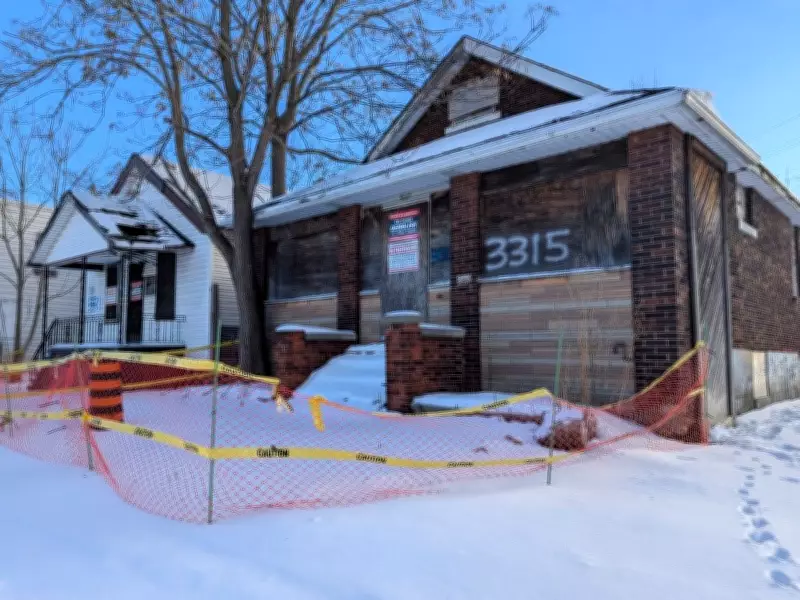
Windsor Council Unanimously Approves Higher Vacant Home Tax Rate
Property owners in Windsor with unoccupied residential units are facing significantly higher financial penalties following a unanimous decision by city council. During 2026 budget deliberations on Monday, council members voted to increase Windsor's vacant home tax from three percent to four percent of assessed property values.
Financial Impact on Vacant Property Owners
According to Janice Guthrie, the city's treasurer and commissioner of finance, the average Municipal Property Assessment Corporation (MPAC)-assessed residential property value in Windsor currently stands at $164,000. With the new four percent tax rate, the average vacant home owner will now pay approximately $6,500 annually.
"At this point, it is higher than the amount of property taxes that they're paying to the city," Guthrie told council members during the deliberations. "An increase of one percent actually could generate more revenue."

Policy Intent and Council Perspectives
Council members emphasized that the primary goal of the tax increase is not revenue generation but rather encouraging property owners to either sell or rent their vacant units. Ward 8 Councillor Gary Kaschak expressed frustration with the current three percent tax's effectiveness, stating that it hasn't sufficiently motivated property owners in his ward to bring homes back into the housing market.
"It doesn't seem to be moving, at least in my ward, these people to put these homes up for sale, or put them up for rentals," Kaschak said of the existing tax. "I think that four percent is a level that's going to make people move."
Program Background and Implementation
The City of Windsor initially launched its separate tax on vacant residential properties in June 2024. The tax applies specifically to residential properties that remain unoccupied for more than 183 days during any taxation year. Property owners suspected of having vacant units are required to complete a declaration under the program.
Guthrie clarified that the tax is calculated based on MPAC-assessed property values rather than as a percentage of regular property taxes. She noted that the last comprehensive property assessment update occurred in 2016, which established the current average residential property value used for calculations.
Revenue Allocation and Program Costs
Any revenue generated beyond the program's operational costs—approximately $100,000 annually—is directed into a reserve fund specifically designated for housing and homelessness initiatives. Guthrie emphasized that the program's financial structure means it could actually cost the city money if successful in eliminating vacant properties entirely.
"The intent of this program is really not to create money to offset the levy, because if we have no homes that are vacant, then it actually costs us money to run the program," Guthrie explained. "The whole intent of this program is to make sure that any homes in the city that can be utilized for housing are being utilized."
Program Results and Future Considerations
Initial implementation data reveals that in 2024, the city taxed 130 vacant homeowners after initially billing 191 property owners, with 61 demonstrating they met exemption criteria. The following year saw 173 property owners billed under the program.
Guthrie noted varying responses from property owners, with some choosing to sell their properties, complete renovations, or convert units to rentals in response to the tax. "It's really up to the property owner," she observed. "Do they see this as a deterrent, or don't they? Some of them did, in fact, put the homes up for sale. Some of them did complete renovations. They are being rented. We're seeing some repeats, but then we're finding new ones coming online."
Looking ahead, council has requested city staff to prepare a report examining the potential for further increasing the vacant home tax to five percent, following a request from Ward 3 Councillor Renaldo Agostino. This suggests that Windsor may continue to escalate financial penalties on vacant properties as part of its broader housing strategy.