The Quebec Professional Association of Real Estate Brokers (QPAREB) has released its residential real estate market statistics for April 2026, revealing a complex picture for the Quebec City Census Metropolitan Area (CMA). While listings have increased for the second consecutive month, the market remains heavily skewed in favor of sellers due to persistent supply shortages.
Sales Decline Across All Property Types
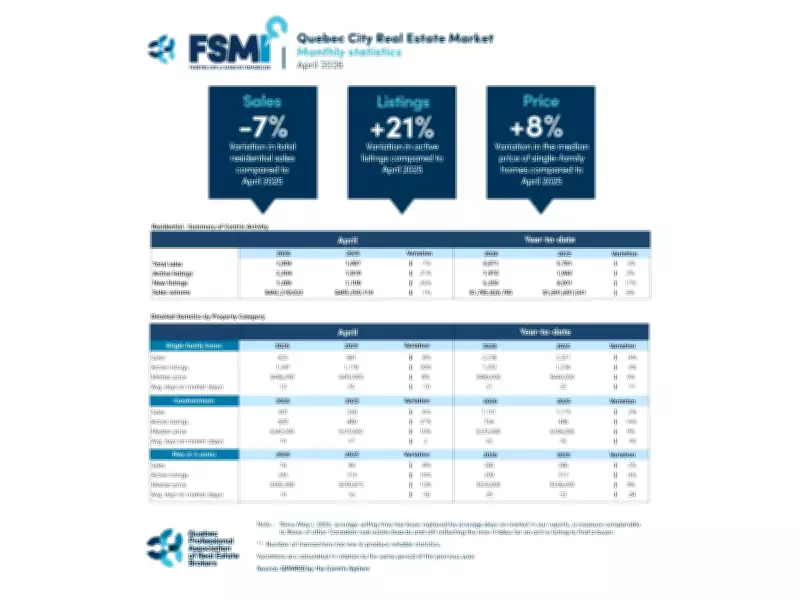
In April 2026, a total of 1,006 residential transactions were recorded in the Quebec City CMA, representing a 7 percent decrease compared to April 2025. Despite this decline, market activity remains well above historical norms when measured against the 10-year average. All property categories experienced drops in sales: single-family homes fell by 8 percent, condominiums by 6 percent, and plexes by 8 percent.
Geographically, all three major sectors of the capital saw reduced activity. The Agglomeration of Quebec City recorded the smallest decline at 4 percent, while the South Shore and Northern Periphery posted decreases of 10 percent and 21 percent, respectively.

Supply Increases but Still Inadequate
The supply of properties rose for a second straight month, following 25 consecutive months of declines. There were 2,204 residential properties listed on the Centris system, marking a significant 21 percent jump compared to April 2025. Condominium listings surged by 27 percent, single-family homes by 20 percent, and plexes by 14 percent.
However, this spring increase in inventory is far from sufficient to offset the prolonged shortage that has plagued the Quebec City area for several years. The number of active listings in April was still 58 percent below the 10-year average, underscoring the depth of the supply crisis.
Market Conditions Ease Slightly
The combination of rising supply and declining sales appears to have halted the tightening of market conditions, which may have peaked in early 2026. Nevertheless, the market remains strongly in favor of sellers across the Quebec City CMA, with competition among buyers still intense.
Charles Brant, QPAREB Market Analysis Director, noted: “Although the market remains dynamic compared to historical averages, we have seen a bit more caution from buyers since the beginning of 2026, largely due to the climate of economic uncertainty. Consumer confidence has weakened amid a slowdown in Quebec’s economy, persistent inflation concerns, and ongoing geopolitical uncertainties, whether related to the conflict in the Middle East or the trade environment with the United States. These factors are prompting many households to take a step back before proceeding with a real estate project.”
Camille Laberge, QPAREB Assistant Director and Senior Economist, added: “In the Quebec City area, this increased buyer caution is unfolding in a market that remains extremely tight. Despite the slight decline in sales, demand continues to run up against limited supply, thus maintaining strong competition among buyers. The recent increase in supply is good news for pent-up demand after several years of shortages, even though it is still far from restoring market balance. Selling times remain exceptionally short, and upward pressure on prices persists across all segments, albeit to a lesser extent than what was observed in 2025.”
Overall, the Quebec City real estate market in April 2026 reflects a delicate balance between rising listings and persistent shortages, with buyer caution tempering activity while sellers continue to hold the upper hand.