Historic Property Shortage Continues to Drive Quebec City Real Estate Sales Decline in January 2026
The Quebec City Census Metropolitan Area experienced a significant contraction in residential real estate transactions during January 2026, according to newly released statistics from the Quebec Professional Association of Real Estate Brokers (QPAREB). The persistent shortage of available properties has created market conditions that continue to strongly favor sellers while limiting transactional activity across all geographic sectors.
Sharp Decline in Residential Transactions
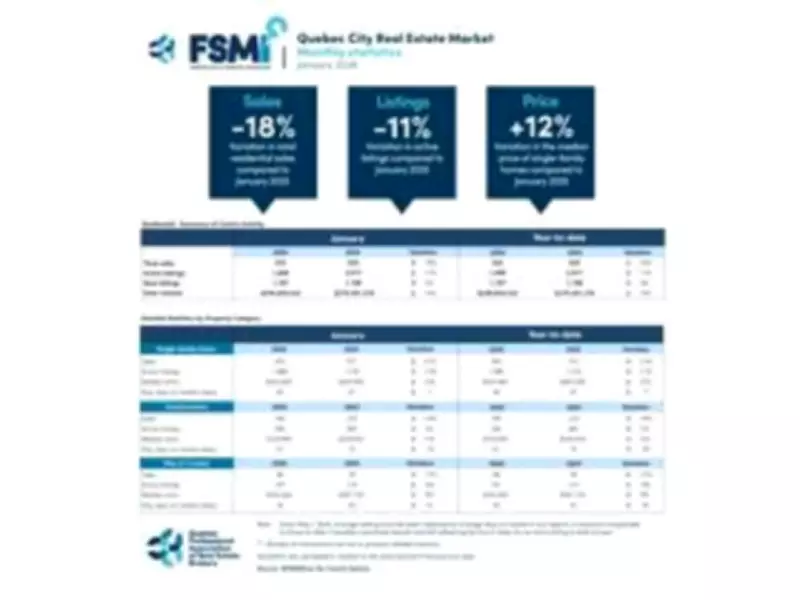
The Quebec City Metropolitan Area recorded only 522 residential transactions in January 2026, representing an 18 percent decline compared to the same period last year. This downward trend affected all property categories without exception:
- 283 single-family homes sold, marking a 21 percent decrease
- 190 condominium transactions, down 14 percent
- 48 plexes sold, representing a 17 percent decline
- One hobby farm transaction completed
Geographically, the sales decline impacted all sectors within the metropolitan area. The South Shore experienced the most substantial drop at 31 percent, followed by the Agglomeration of Quebec City at 15 percent, and the Northern Periphery at 7 percent.

Unprecedented Inventory Shortage
The supply of available properties declined for a 24th consecutive month, reaching its lowest level ever recorded in the region's history. This ongoing contraction is primarily driven by the scarcity of single-family homes, which decreased by 17 percent, and plexes, which declined by 6 percent. In contrast, the number of active condominium listings increased by 5 percent, marking the first increase in this category since September 2023.
This persistent shortage continues to maintain market conditions that strongly favor sellers across all property categories. The number of months of inventory in January 2026 for the Quebec City CMA has never been lower, creating an exceptionally tight market environment.
Upward Pressure on Prices
The constrained supply continued to exert substantial upward pressure on property prices throughout the region. Median prices showed significant increases across all residential categories:
- Single-family homes rose by 12 percent
- Condominiums increased by 15 percent
- Plexes appreciated by 9 percent
Overbidding remains widespread, though showing some decline from previous periods. In January 2026, nearly three in ten properties sold for more than 5 percent above the asking price, compared with nearly four in ten during spring 2025.
Market Velocity and Expert Analysis
The average number of days on market remained under two months for all property categories, indicating continued demand despite the challenging market conditions. Single-family homes averaged 40 days on market, condominiums 41 days, and plexes 59 days.
"January's data for the Quebec City area confirms that the decline in sales is a continuation of the trend seen at the end of 2025 and remains primarily driven by the historic shortage of properties for sale," explains Charles Brant, QPAREB Market Analysis Director. "Inventory has reached an unprecedented low, particularly for single-family homes and plexes, severely limiting transactional activity. In this context of extreme scarcity, upward pressure on prices remains very strong, and affordability is becoming an increasingly decisive issue for buyers. Demand remains present, though more cautious."
Camille Laberge, QPAREB Assistant Director and Senior Economist, adds: "The stabilization of interest rates announced by the Bank of Canada improves market predictability for buyers, but the scarcity of supply and rising affordability challenges will continue to shape market dynamics in 2026."
The QPAREB statistics are based on the real estate brokers' Centris provincial database, providing comprehensive market insights for the Quebec City Census Metropolitan Area. The ongoing property shortage represents a significant challenge for prospective buyers while creating advantageous conditions for sellers in one of Canada's most historically significant urban centers.