GTA Housing Market Tightens as Listings Decline Outpaces Sales Drop
The Greater Toronto Area resale housing market experienced tightening conditions in February 2026 compared to the same period last year, according to the latest data from the Toronto Regional Real Estate Board. While home sales declined year-over-year, the decrease in new listings was substantially more pronounced, creating a market environment where supply is contracting faster than demand.
February 2026 Market Statistics Reveal Significant Shifts
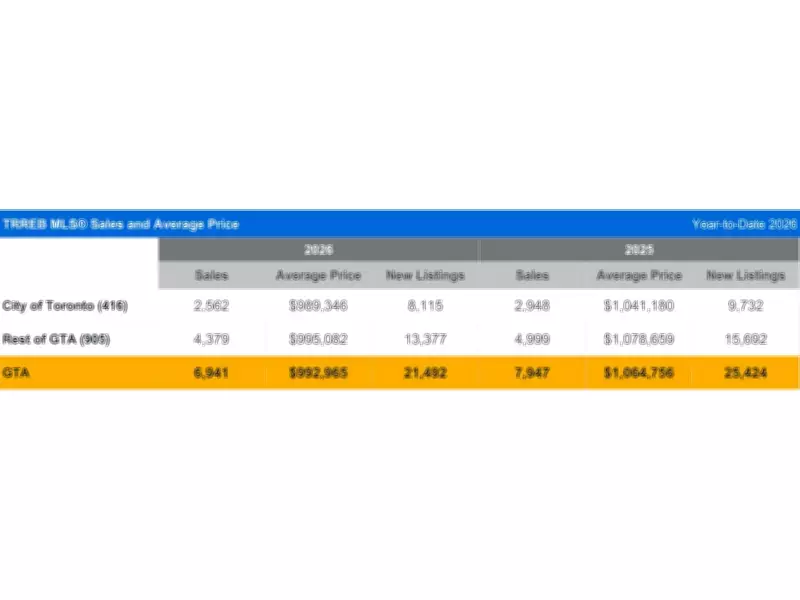
GTA REALTORS® reported 3,868 home sales through TRREB's MLS® System in February 2026, representing a 6.3 percent decrease compared to February 2025. Meanwhile, new listings entered into the system totaled 10,705, showing a much steeper decline of 17.7 percent year-over-year. This disparity between sales and listing reductions indicates a tightening market where available inventory is shrinking at an accelerated pace.
On a seasonally adjusted basis, both February home sales and new listings decreased month-over-month compared to January 2026, with new listings falling by a greater monthly rate than sales. The MLS® Home Price Index Composite benchmark declined by 7.9 percent year-over-year in February 2026, while the average selling price of $1,008,968 reflected a 7.1 percent decrease compared to February 2025.

Pent-Up Demand and Buyer Psychology
"Many would-be homebuyers are waiting for selling prices to level off before moving into the market," explained TRREB President Daniel Steinfeld. "If new listings continue to trend lower through the spring, competition between homebuyers will increase, supporting home prices and a recovery in sales."
TRREB Chief Information Officer Jason Mercer provided additional insight into buyer behavior, noting substantial pent-up demand in the GTA ownership market. "More than 100,000 buyers are holding off on making a home purchase," Mercer stated. "Buyers are waiting for selling prices to level off and for positive news on the trade front. Once we see both, there could be substantial momentum driving home sales in the second half of this year and into 2027."
Long-Term Market Sustainability Concerns
The decline in new listings aligns with recent polling results from Ipsos, which indicate that listing intentions are down for 2026. This trend raises questions about long-term market sustainability and housing availability in Canada's largest metropolitan area.
"The long-term sustainability of the GTA housing market depends upon the industry's ability to bridge the gap between condominium apartments and traditional single-family homes," emphasized TRREB Chief Executive Officer John DiMichele. "TRREB, with its partners in the Housing Advancement Coalition, is urging the Federal and Provincial Governments to take immediate targeted action to pave the way for increased 'missing middle' home construction."
Market Outlook and Recovery Indicators
Real estate experts are closely monitoring several key indicators that could signal market recovery:
- Price stabilization: As selling prices approach a leveling point, hesitant buyers may re-enter the market
- Listing trends: Continued decline in new listings could increase competition among remaining buyers
- Economic factors: Positive developments in trade and broader economic conditions could boost buyer confidence
- Policy interventions: Government actions addressing housing supply constraints could impact long-term market dynamics
The current market conditions represent a complex interplay between buyer caution, supply constraints, and price adjustments. While February data shows declines across multiple metrics, the substantial pent-up demand identified by TRREB officials suggests potential for market recovery once key psychological and economic thresholds are crossed.
Industry observers will be watching spring market activity closely, as traditional seasonal patterns combined with current market dynamics could provide clearer signals about the trajectory of GTA housing through the remainder of 2026 and into the following year.