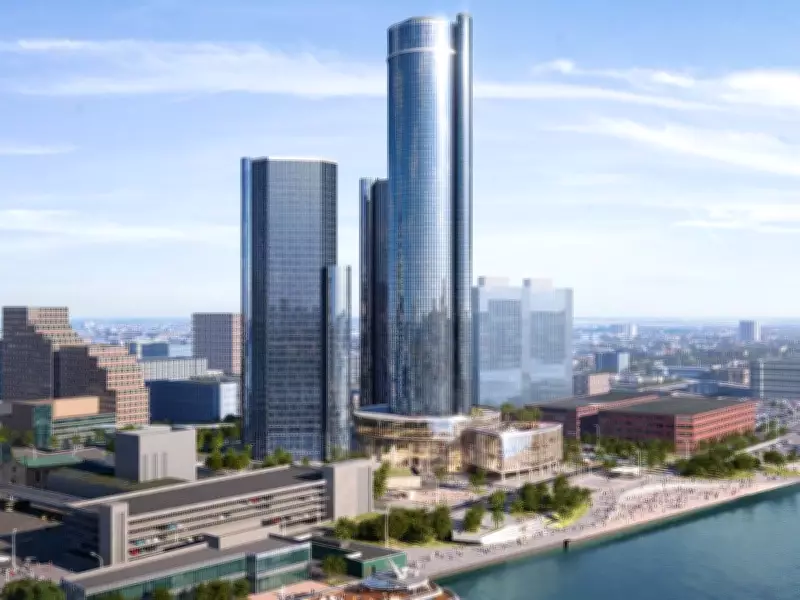
Detroit's $2.2 Billion Renaissance Center Overhaul to Transform Iconic Skyline Visible from Windsor
For nearly five decades, the Renaissance Center has stood as the defining feature of Detroit's skyline, its distinctive cluster of towers forming a familiar silhouette from Windsor's waterfront. This iconic landmark is now poised for its most dramatic transformation since its construction in the 1970s.
Ambitious Redevelopment Plan
A monumental US$1.6 billion (approximately C$2.2 billion) redevelopment project, currently in its conceptual phase, will fundamentally reshape the Renaissance Center complex. The most significant change involves the planned demolition of Towers 300 and 400, the two 39-storey attached buildings that currently face the Detroit River.
Eric Larson, CEO of the Downtown Detroit Partnership, expressed enthusiasm about the proposal during a recent Windsor-Essex Chamber of Commerce meeting. "I think there are a number of things that are very exciting about, not only the vision that has been proposed, but also the ability to preserve what is a very important iconic aspect of our skyline," Larson stated.

Creating Public Space and Connectivity
Where the twin towers currently stand, developers envision creating a substantial six-acre public park alongside new promenades that will provide uninterrupted pedestrian access between downtown Detroit and the waterfront. This represents a significant departure from the Renaissance Center's original 1970s design philosophy.
"That would be another six acres of public land that would be added to what has already been a five-mile improvement of our riverfront," Larson emphasized, highlighting the project's potential to enhance public access to Detroit's greatest natural resource.
Architectural Transformation and Mixed-Use Development
The proposal, spearheaded by billionaire Dan Gilbert's Bedrock Detroit in partnership with General Motors, includes several key architectural changes:
- The sprawling podium at the base of the towers will be completely removed
- The remaining buildings will be reconfigured into a mixed-use development featuring residential units, hotel space, and modern offices
- The 73-storey central tower, Michigan's tallest building and current home to the Detroit Marriott hotel, will remain standing
- Hotel rooms will be reduced to approximately 850, with upper floors converted to apartments
- One remaining 39-storey tower will be renovated for continued office use
- The other tower will be converted into housing, including a portion designated as affordable units
Regional Impact and Timing
This massive redevelopment coincides with General Motors' planned 2026 relocation of its headquarters to the nearby Hudson's Detroit building on Woodward Avenue. The timing creates a period of significant transformation for Detroit's urban landscape, with multiple iconic projects reshaping the city's profile.
Larson highlighted the cross-border significance of the project, noting, "For Windsor and for Detroit, our greatest natural resource and natural amenity is the Detroit River, or the river that lies between us. For both of our riverfronts to see the level of investment, but also enhanced activity, and most importantly, truly equitable access, is very exciting."
The Renaissance Center transformation represents not just an architectural evolution but a fundamental rethinking of how Detroit connects with its waterfront and how this iconic skyline will appear to generations of Windsor residents in the decades to come.