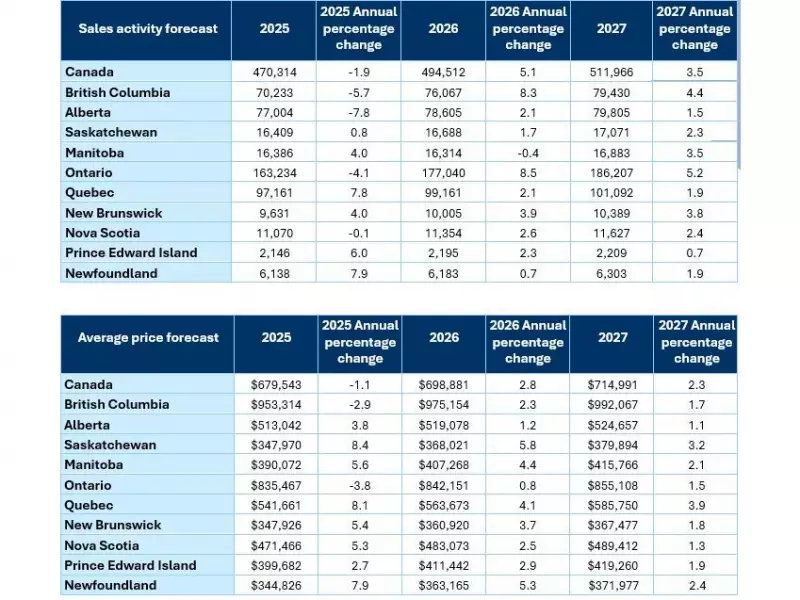
The Canadian Real Estate Association (CREA) has released an updated outlook for the country's resale housing market, providing revised projections for 2026 and extending its forecast into 2027. The new data, issued on January 15, 2026, anticipates a rebound in sales activity and modest price growth, signaling a shift from the subdued market conditions of recent years.
Pent-Up Demand from First-Time Buyers to Fuel 2026 Recovery
After a period of significant slowdown influenced by high interest rates and economic uncertainty, the market showed signs of life in mid-2025. CREA notes that a rally beginning in April led to a 12% climb in sales by August, setting a precedent for the coming year. The association identifies pent-up demand, particularly from first-time buyers who have been sidelined for nearly four years, as the primary engine for growth in 2026.
While affordability challenges persist compared to pre-2020 levels, CREA suggests that interest rates have likely fallen enough to make homeownership attainable for many. A key moment came on October 29, 2025, when the Bank of Canada signaled that rates were near their peak, potentially encouraging borrowers waiting for fixed-rate mortgages.

Provincial Divergence in Sales and Price Growth
CREA forecasts that approximately 494,512 residential properties will be sold via Canadian MLS® Systems in 2026, representing a 5.1% annual increase. This national growth is expected to be unevenly distributed, driven largely by stronger recoveries in British Columbia and Ontario, where sales are projected to rise by more than 8%. Other provinces, where sales are already at higher levels and supply is more constrained, are likely to see gains of less than half that rate.
On the price front, the national average home price is forecast to rise by 2.8% to $698,881 in 2026. British Columbia, Alberta, Ontario, and Nova Scotia are anticipated to see smaller increases. Conversely, provinces like Saskatchewan, Quebec, and Newfoundland and Labrador, which have seen robust price growth bolstered by record population increases, are forecast for larger gains. However, price growth in these hotter markets is expected to cool, moving from the 6%-8% range in 2025 to a more moderate 3%-6% range in 2026.
Supply Dynamics and Long-Term Outlook
A critical factor to watch in 2026 will be inventory levels. CREA warns that if demand is disproportionately driven by first-time buyers as expected, it could accelerate the depletion of available listings. This is because first-time buyers typically remove supply from the market without immediately adding new listings back into the pool.
Looking beyond 2026, CREA has also extended its modeling to include projections for 2027, indicating a focus on the market's medium-term trajectory as it stabilizes from the volatility of the early 2020s. The updated forecast suggests a cautious optimism, with the market transitioning from a period of correction to one of measured, demand-driven growth.