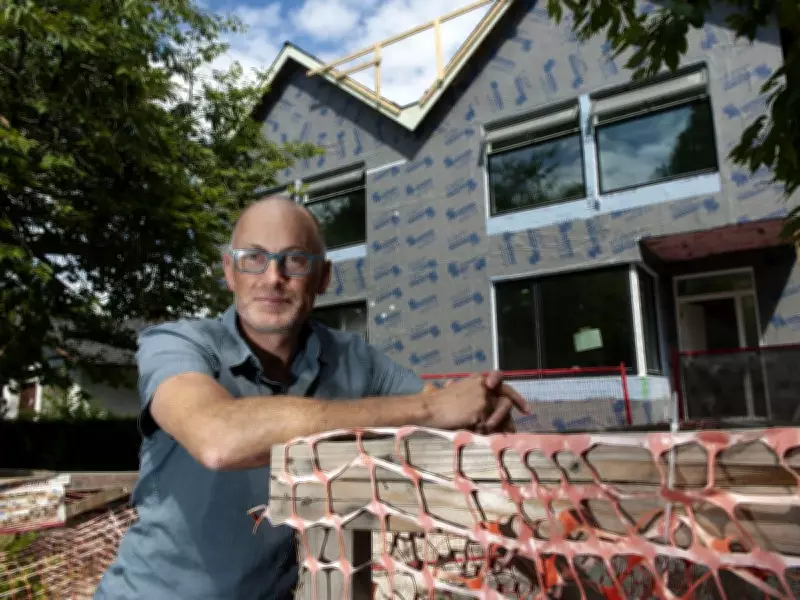
Bryn Davidson, a politically progressive house designer, builder, and climate-crisis activist based in Vancouver, has emerged as a pivotal figure in reshaping the city's residential landscapes. A transplant from California, Davidson has leveraged his influence to advocate for increased population density through various housing forms, including laneway houses, duplexes, fourplexes, sixplexes, and mid-rise apartment buildings on side streets.
Embracing Architectural Disruption
As outsized, blocky structures proliferate across Vancouver and other British Columbia cities, many residents express shock and dismay. However, Davidson, known as a disrupter in the housing sector, offers no apologies for the thousands of fourplex and sixplex dwellings approved in Metro Vancouver, with over 540 alone in the city. He provocatively states, "It's OK if some of the multiplexes are ugly," using a term increasingly applied to small apartment buildings.
Davidson elaborates, "My favourite blocks have a mix of styles and some houses that are weird and ugly. It's so much better than neighbourhoods that are pleasantly and boringly unoffensive. Excessive design guidelines are the death of culturally relevant architecture."

The 'Teenage Awkward Years' of Housing
Referring to fourplex and sixplex dwellings—which the B.C. NDP prezoned more than two years ago for virtually all single-detached lots across the province—Davidson describes them as "the teenage awkward years" of housing. He prefers to call them small apartment buildings, emphasizing their role in urban evolution.
"As our neighbourhoods transition from car-dependent suburbs into dense, walkable neighbourhoods, we'll have some awkward juxtapositions. That's OK," Davidson asserts. "It's part of the process that led to the creation of any real city that you would now want to go visit on vacation."
A Legacy of Innovation
Davidson's company, Lanefab Design/Build, constructed Vancouver's first laneway house sixteen years ago, marking the beginning of his deep involvement in zoning updates. He has participated in key policy shifts, including allowing basement suites to open into front yards and citywide upzoning for duplexes, as well as crafting small-apartment zoning for both Vancouver and Burnaby.
His advice to residents unsettled by oversized apartment buildings emerging nearby is straightforward: overcome anger and embrace change. "Every new building type is preceded by transient angst," he notes. "As a community we have to figure out how to process our sense of grief that unfolds from change, without thinking we can or should try to block everything. Growing up is a natural process, but involves some hard letting go at times."
Broader Implications for Urban Development
Davidson's perspectives highlight ongoing tensions in urban planning, where the push for density clashes with aesthetic preferences and community cohesion. His advocacy underscores a belief that functional, diverse housing—even if visually unconventional—is essential for addressing housing shortages and fostering vibrant, sustainable cities.
This stance resonates amid broader debates, such as Metro Vancouver mayors calling on the B.C. NDP to reconsider multiplex upzoning and concerns over population dynamics impacting the housing industry. Davidson's work continues to challenge conventional norms, positioning him as a key voice in the future of urban living in British Columbia.