1889: A Federal Parliamentarian's Dual Role in Pioneer Vancouver Real Estate
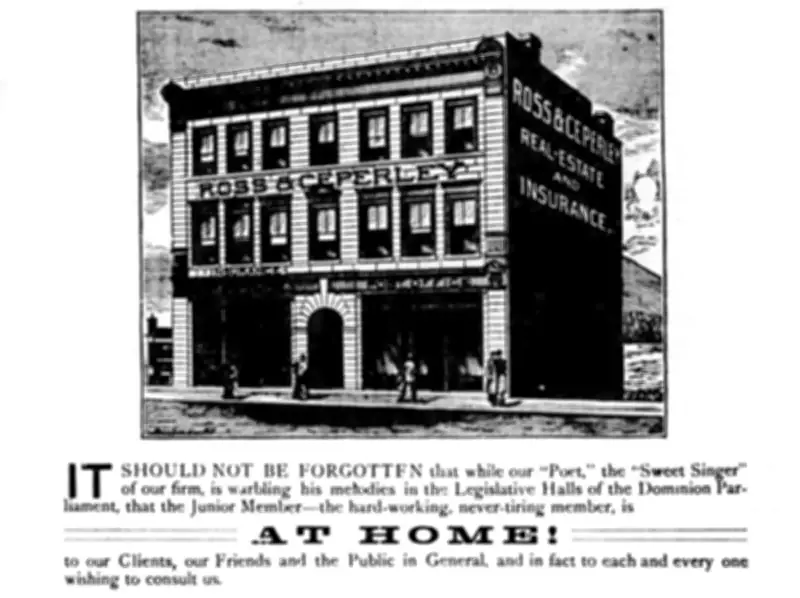
On February 14, 1889, a peculiar advertisement appeared in the Vancouver News Advertiser from the real estate firm Ross and Ceperley. The ad featured poetic language referring to their "Poet" warbling melodies in the Legislative Halls of the Dominion Parliament while the junior member remained "AT HOME!" to clients. This cryptic message revealed the unusual dual career of Arthur Wellington Ross, a federal member of Parliament for Manitoba's Lisgar riding who simultaneously operated a major real estate business in Vancouver.
The Political Poet of Real Estate
Arthur Wellington Ross was no ordinary real estate salesman. Born in Nairn, Ontario in 1846, he moved to Winnipeg in 1877 where he established himself as a lawyer before entering politics. He was elected to the Manitoba legislature in 1878 and then won the federal seat for Lisgar in 1882, securing re-election in 1887 and 1891. Despite representing a Manitoba constituency, Ross spent significant time on Canada's west coast beginning in the summer of 1884.
Ross initially made his fortune during Winnipeg's real estate boom in the late 1870s and early 1880s, with the city's most exclusive street, Wellington Crescent, named in his honor. However, when that boom collapsed, Ross turned his attention westward. His political connections proved invaluable when he helped the Canadian Pacific Railway assemble land for its western terminus at Granville, the tiny townsite on Burrard Inlet that would become the City of Vancouver in 1886.

Ross and Ceperley: Vancouver's Premier Real Estate Firm
In January 1888, Ross partnered with Henry Tracy Ceperley to establish Ross and Ceperley, a real estate and insurance firm located in the Post Office Block at 313 West Hastings Street. The firm quickly became known for its large, colorful advertisements that promoted Vancouver's potential with bold claims. One ad from the summer of 1888 declared Vancouver "The Meeting Place of the Occident and the Orient" and predicted it would soon become "the largest city on the Pacific coast excepting San Francisco."
When Parliament was in session, Ross would take the train back to Ottawa, leaving day-to-day operations to his business partner Ceperley. This arrangement allowed him to maintain both his political career and his lucrative real estate business simultaneously. Ross appears in the famous H.T. Devine photograph of realtors selling property from a stump in 1886, cementing his place in Vancouver's early development history.
Political Connections and Vancouver's Development
Ross's political influence extended beyond his parliamentary duties. Through his Ottawa connections, he helped Vancouver secure a lease from the federal government for a 1,000-acre naval reserve at the top of the downtown peninsula, which eventually became Stanley Park. His family connections further embedded him in Vancouver's power structure—his brother-in-law was Malcolm McLean, Vancouver's first mayor.
Interestingly, Ross had initially been a critic of the CPR's deal with the federal government but switched positions in 1884, becoming a staunch defender of the railway as "crucial to the prosperity of the northwest and Canada." This shift coincided with his growing involvement in Vancouver real estate development through his connections with the railway.
The 1889 advertisement that described Ross as the firm's "Poet" and "Sweet Singer" highlights how openly his dual roles were acknowledged at the time. In an era when Vancouver's population numbered only about 9,000 people, such political-business entanglements were apparently commonplace and accepted as part of the frontier city's development.
Arthur Wellington Ross's story provides a fascinating glimpse into the intersection of politics and business during Canada's early nation-building period, demonstrating how personal ambition, political power, and economic development were often inextricably linked in the settlement of the Canadian west.