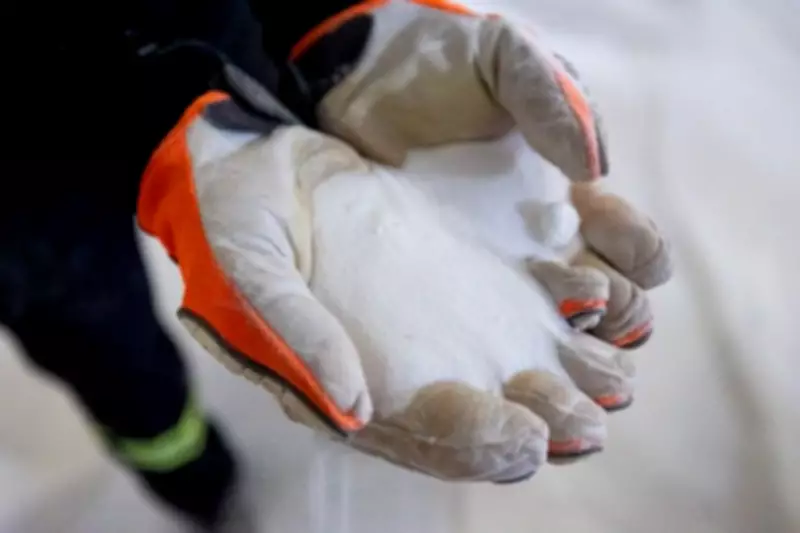
Saskatchewan Mineral Company Sees Future in Premium Potash Fertilizer
Saskatchewan Mining and Minerals Inc. (SMMI) is making a strategic bet that a specialized potash and sulphur chemical fertilizer will drive its future growth and solidify its position in the province's mineral sector. The company recently announced the acquisition of the Quill Lakes facility near Wynyard, Saskatchewan, a move that accelerates its entry into the premium fertilizer market.
Accelerating Production Through Acquisition
While SMMI has been developing its own sulphate of potash (SOP) project at Chaplin for the past five years, the $30.8 million acquisition of the 40,000-tonne-per-year Quill Lakes facility from Compass Minerals allows the company to integrate SOP into its portfolio much sooner than building from scratch. "For us, it's always been part of our future. This just allowed us to move into it faster," said Megz Reynolds, SMMI's director of strategic integration.
The acquisition has temporarily paused the company's original Chaplin SOP project, which was announced in 2021 with expected production of 50,000 to 100,000 tonnes annually. A revised completion date is now set for 2028 or later.

What Makes SOP a Premium Product?
Sulphate of potash is a chemical fertilizer made from potash that undergoes processing to add sulphur nutrients and remove chlorine content. This makes it particularly valuable for specialty crops such as:
- Tobacco
- Coffee
- Fruits
- Other high-value agricultural products
The premium nature of SOP comes from its chlorine-free formulation, which is less harmful to sensitive crops and soil systems compared to traditional potash fertilizers.
Saskatchewan's Unique Mineral Advantage
Saskatchewan possesses a remarkable geological advantage that makes it particularly suited for SOP production. "One of the really unique things with Saskatchewan is that resource base, the minerals there," Reynolds explained. "There's nowhere else in the world that you find potash in its natural mineral form sitting next to the alkali or sodium sulphate minerals."
This natural proximity of resources creates a competitive advantage for Saskatchewan-based producers. The province is already the world's largest producer of potash, with an estimated output of nearly 25 million tonnes annually according to 2024 data from Natural Resources Canada.
Company Background and Future Plans
SMMI has deep roots in Saskatchewan's mineral industry, having operated as a provincial Crown corporation from 1947 until 1988. The private company now holds all commercially-viable sodium sulphate reserves in the province, according to Reynolds.
The company's sodium sulphate plant in Chaplin has been supplying the Quill Lakes facility even before the acquisition, creating natural synergies between the operations.
Looking forward, SMMI has ambitious expansion plans:
- Complete the Chaplin SOP operation by 2028 or later
- Develop the Fox Valley project near its other sodium sulphate reserve
- Potentially produce over 340,000 tonnes of premium fertilizer annually
The Fox Valley project alone could produce between 250,000 and 400,000 tonnes of SOP annually, significantly expanding the company's capacity in the premium fertilizer market.
Strategic Significance for Saskatchewan
This move represents more than just corporate expansion—it reinforces Saskatchewan's position in value-added mineral production. "I think we're known in Saskatchewan for our minerals, for our value-added and our mineral production, and this just further helps anchor that," Reynolds noted.
By focusing on premium, processed fertilizers rather than just raw mineral extraction, SMMI is contributing to the evolution of Saskatchewan's mining sector toward higher-value products that command better prices in international markets.
The company's strategy leverages Saskatchewan's natural resources while creating specialized products for global agricultural markets, particularly those demanding chlorine-free fertilizers for sensitive, high-value crops.