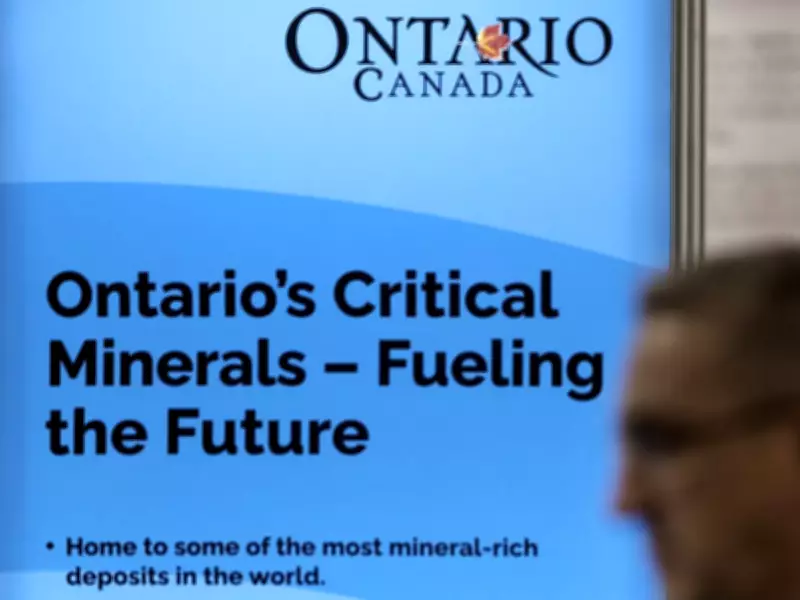
Ontario Emerges as Premier Canadian Mining Investment Hub with Global Standing
Ontario has solidified its position as the most attractive jurisdiction in Canada for mining sector investment, according to a comprehensive report released by the Vancouver-based Fraser Institute. The province now ranks second globally, trailing only Nevada, marking a dramatic ascent from its 15th place position in the previous year's assessment.
Canadian Jurisdictions Show Mixed Performance in Global Rankings
Saskatchewan demonstrated notable improvement, climbing to third place globally from seventh last year. However, Ontario and Saskatchewan remain the only two Canadian jurisdictions to secure positions within the top ten for overall investment attractiveness in the Fraser Institute's Annual Survey of Mining Companies. South Australia and Arizona complete the top five global rankings.
Elmira Aliakbari, director of natural resource studies at the Fraser Institute and co-author of the report, noted that "results across Canada are mixed" compared to 2024 data. "For some provinces, like Ontario and Saskatchewan, we see a pretty significant improvement," she emphasized during the report's presentation.

Factors Driving Ontario's Remarkable Ascent
The report attributes Ontario's substantial rise in the rankings to decreased concerns among mining professionals regarding several key factors:
- Provincial taxation regime
- Availability of skilled labor
- Political stability
These improvements have positioned Ontario as a particularly favorable environment for mining investment, with the province now considered more attractive than all other Canadian jurisdictions for mineral sector development.
Challenges Persist in Other Canadian Regions
While Ontario and Saskatchewan show promising progress, other Canadian provinces and territories face significant challenges. Aliakbari highlighted that jurisdictions such as Manitoba and Yukon "have declined significantly this year compared to last." The Northwest Territories and Nova Scotia ranked at the bottom among Canadian jurisdictions, with New Brunswick and Nova Scotia occupying the lowest-rated positions nationally in the previous assessment period.
Methodology and Policy Implications
The Fraser Institute's overall scores derive from responses provided by 256 mining industry professionals and represent a composite of two distinct measures:
- Mineral potential assessment
- Public policy perception evaluation
Aliakbari observed that Canadian jurisdictions with lower overall investment attractiveness typically perform poorly on the public policy perception component. "This means these jurisdictions have failed to capitalize on their strong mineral potential due to a lack of solid policy environment," she explained.
British Columbia serves as a prime example of this dynamic, performing well on mineral endowment assessments while its overall ranking suffers due to negative perceptions of public policy. Survey respondents expressed particular concern about:
- Uncertainty regarding protected areas
- Disputed land claims
- Environmental regulations
Federal Priorities and Industry Concerns
The federal government has articulated goals to "strengthen critical minerals supply and promote innovation and sustainable practices across critical minerals value chains." Recent defense industrial strategy documents further emphasize national aspirations to secure "a Canadian supply of critical raw materials" deemed "vital to the defence supply chain."
However, persistent concerns within the mining industry about public policy in specific Canadian jurisdictions may hinder progress toward these federal objectives. Aliakbari recommends that governments strengthen regulatory environments to improve Canada's collective performance. She stressed that policymakers must recognize that "mineral deposits alone are not enough. We need to adapt policies that attract committed investment as well."

The survey results highlight the critical intersection between natural resource potential and policy frameworks in determining investment attractiveness. As global competition for mining investment intensifies, Canadian jurisdictions face increasing pressure to balance mineral development with regulatory certainty and policy stability.