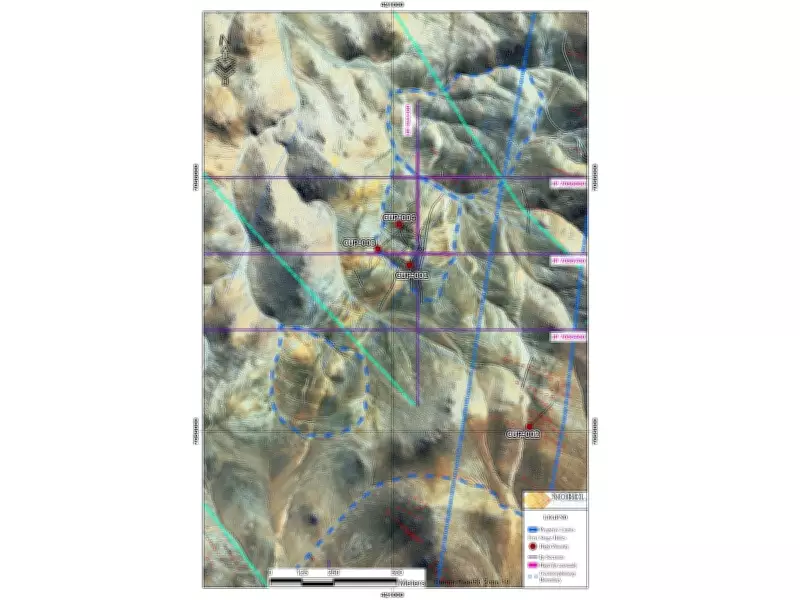
In a significant development for the mining sector, Nobel Resources Corp. has announced the discovery of a new mineralized porphyry copper system at its Cuprita project located in northern Chile. This marks a pivotal moment for the company as it conducts its inaugural diamond drill program on this highly prospective site.
Exploration Breakthrough in Northern Chile
The identification follows extensive geological and geophysical surveys conducted over the past year by Nobel's Chilean technical team. These surveys pinpointed key characteristics commonly associated with mineralized porphyry copper systems in the region, prompting the commencement of a diamond drill campaign in January 2026.
Drilling Results Reveal Promising Mineralization
The fourth drill hole in the program, designated CUP004, intersected more than 100 meters of copper-bearing mineralized porphyry. While assays are still pending and not all intervals are expected to be of commercially exploitable grade, the early technical results are highly encouraging. Porphyry systems are known for their large-scale targets, and this discovery underscores the project's potential.

Drill hole CUP003, which appeared to clip the edge of the system, intercepted weakly mineralized porphyry. This provided crucial vectors based on observed alteration, aiding in further exploration planning.
Detailed Geological Findings
From a depth of 218 meters in CUP004, there is a notable increase in tourmaline veins, with the rock transitioning into an intrusive breccia containing porphyry clasts. Portable X-ray fluorescence (XRF) measurements using an Olympus INNOV-X Delta Premium XRF Analyzer recorded copper values up to 1,700 ppm within this breccia. It is important to note that portable XRF measurements are point-source and not as accurate as assays, but they serve as a valuable field tool for estimating grades and guiding drill hole planning.
Further down, from 285.5 meters to 382 meters, a sulfide-rich interval was identified, characterized by an increasing density of quartz-sulfide veins with disseminated pyrite ± chalcopyrite and locally bornite. Alteration in this zone is primarily sericite-chlorite, with moderate to strong intensity. XRF readings in this section reached up to 2.9% copper in chrysocolla-bearing veinlets and 2.6% copper in pyrite-chalcopyrite veinlets.
The decrease in generalized oxidation and the appearance of primary sulfides suggest a transition from lithocap conditions to a mineralized domain. Below a post-mineralization dike from 382 to 408.8 meters, weakly mineralized porphyry was intercepted, with the hole concluding at 460.6 meters depth.
Context and Caution
The Cuprita project is situated in a region known for copper deposits, but information about adjacent properties is provided for context only and should not be relied upon as indicative of the project's mineralization, grade, continuity, or potential. Readers are advised to exercise caution when interpreting such data.
This discovery positions Nobel Resources Corp. as a key player in copper exploration in Chile, with ongoing drilling and future assay results eagerly anticipated by the industry.