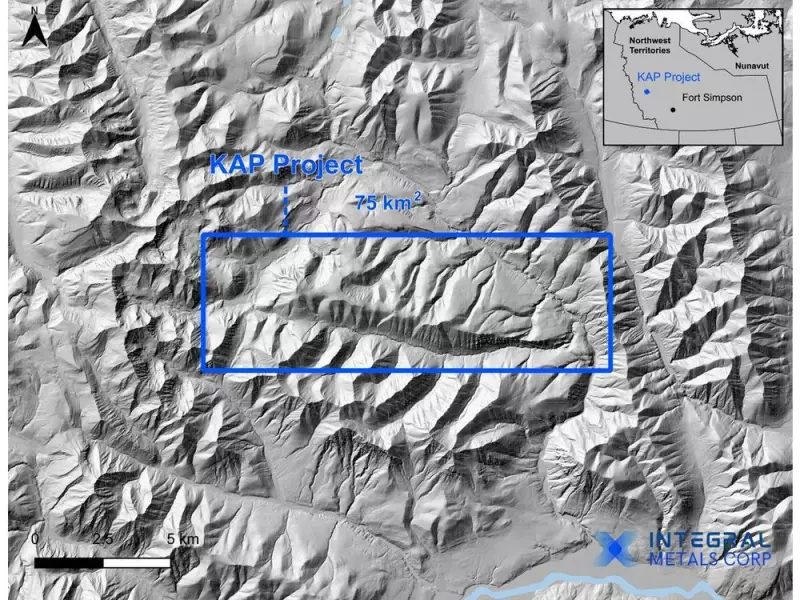
CALGARY, Alberta – In a significant development for Canada's critical minerals sector, Integral Metals Corp. (CSE: INTG | FSE: ZK9) has announced highly promising assay results from its 2025 diamond drilling program at the KAP Project, located in the remote Mackenzie Mountains of the Northwest Territories. The program, consisting of seven drill holes, has successfully confirmed the presence of high-grade zinc mineralization enriched with the strategically important by-products gallium and germanium.
Exceptional Drill Results Confirm and Extend Mineralization
The 2025 exploration campaign was designed with four key objectives: to verify historical zinc intercepts, test northerly extensions, evaluate gallium and germanium distribution, and understand the geological controls of the deposit. The results, released on December 4, 2025, exceeded expectations, confirming both grade and continuity.
Among the standout intercepts, drill hole KAP-25-001B, targeting the Central Zone, intersected a remarkable 17.72% zinc over 5.60 metres. This interval also contained 228 parts per million (ppm) gallium and 294 ppm germanium. Within that broader zone, a high-grade core assayed 28.26% zinc, 362 ppm Ga, and 473 ppm Ge over 3.45 metres, powerfully verifying historical data.

Another hole, KAP-25-002, also in the Central Zone, returned 14.27% Zn, 215 ppm Ga, and 159 ppm Ge over 5.00 metres. Perhaps most encouraging for the project's expansion potential were the results from step-out drilling in the North Zone. Hole KAP-25-006, the furthest step-out completed, delivered one of the broadest mineralized intervals to date: 8.28% Zn, 61 ppm Ga, and 80 ppm Ge over 16.15 metres, confirming that mineralization extends well beyond previously known limits.
Unlocking a Hybrid Mineral System
The 843-metre drill program has provided crucial new geological insights. The mineralization is hosted within sphalerite-bearing breccia horizons, and the company's observations of collapse breccias and recrystallization fronts have helped refine the deposit model.
Integral Metals now interprets the KAP Project as an emerging hybrid Mississippi Valley-Type (MVT) and Carbonate Replacement Deposit (CRD). This model suggests that earlier, basin-derived brine mineralization has been overprinted and upgraded by hotter, metal-rich hydrothermal fluids. This complex process is credited with improving the overall grade profile and significantly enhancing the exploration potential across the property.
The consistent association of gallium and germanium with the high-grade zinc sphalerite is a particularly valuable aspect of the discovery. Both gallium and germanium are classified as critical minerals by the Canadian and U.S. governments, essential for advanced technologies like semiconductors, fiber optics, and solar panels. Their presence as by-products could substantially improve the project's economics.
Strategic Implications and Next Steps
The success of the 2025 program validates the historical work at KAP and demonstrates substantial expansion potential along a north-northwest trend. The confirmation of high-grade zinc, coupled with meaningful concentrations of critical minerals, positions the KAP Project as a strategically important asset in a secure North American supply chain.
For Integral Metals, these results provide a strong foundation for planning future exploration. The company has successfully validated the mineralized corridor in the Central Zone and proven its extension in the North Zone. The next steps will likely involve further step-out drilling to define the full extent of the system and additional metallurgical testing to understand the recovery of all valuable metals.
This discovery underscores the continued mineral potential of Canada's North, particularly the Mackenzie Mountains, and highlights the growing importance of polymetallic deposits that host the critical minerals vital for the global energy transition.