

A new survey conducted by Express Employment Professionals and The Harris Poll has uncovered a troubling trend in Canada's job market: job seekers are increasingly using artificial intelligence to exaggerate their skills on resumes, creating a significant reality gap that employers are struggling to navigate.
The Resume Reality Gap
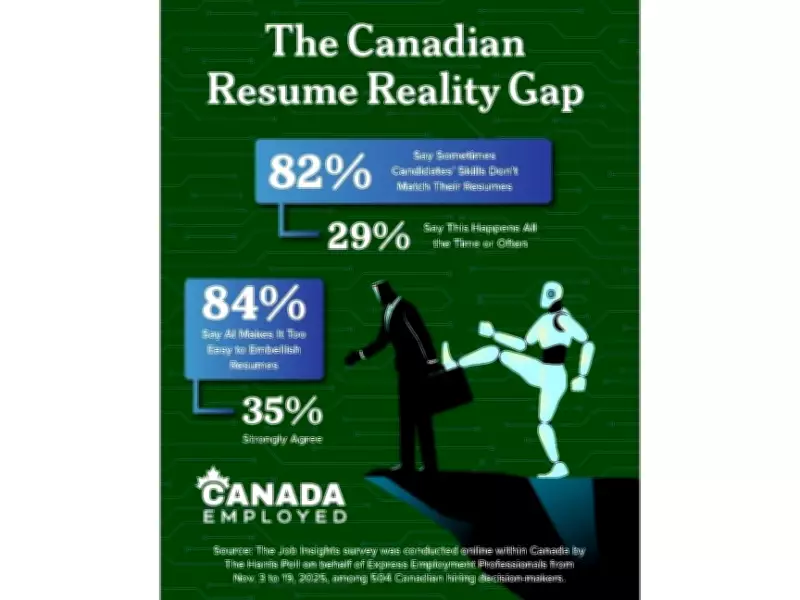
The survey reveals that 82% of Canadian hiring managers report that candidates' resumes don't match their real-world skills at least sometimes, with nearly one in three (29%) saying this happens all the time or often. This discrepancy between claimed abilities and actual capabilities has become a major concern for employers across various industries.
AI's Role in Resume Embellishment
With AI tools now readily available to every job applicant, companies are sounding the alarm about how technology is facilitating resume exaggeration. A substantial majority of hiring managers (84%) believe AI makes it too easy to embellish resumes, with 35% strongly agreeing that this trend is becoming a serious hiring risk that could undermine workforce quality.

Despite widespread employer concerns about skill inflation, only 22% of job seekers admit to listing skills they don't actually possess. This significant gap between employer perceptions and applicant admissions raises red flags about the integrity of the hiring process and the potential consequences for workplace productivity.
Wild Resume Claims That Backfired
Hiring managers shared numerous examples of resume exaggerations that unraveled during the hiring process or once candidates began working:
- A candidate claimed to have graduated at the top of their class from a prestigious university, but when questioned by a hiring manager who attended the same institution, admitted they had never been a student there.
- An applicant falsely claimed bilingual proficiency in English and French, resulting in lost sales opportunities for the company that hired them.
- A job seeker applying for a vice president position listed ten years of experience despite not being old enough to have worked that long.
- An applicant with claimed years of experience working with children began yelling at toddlers on their first day and failed to notice when children left the room unattended.
Common Resume Exaggerations
Job seekers themselves admitted to various forms of resume creativity, including:
- Listing advanced computer programming skills they did not possess
- Changing previous job titles to ones they believed would be more attractive to potential employers
- Claiming to have left previous employers on good terms when the opposite was true
- Extending the duration of their employment at previous companies
The Importance of Integrity in Hiring
Bob Funk Jr., CEO, President and Chairman of Express Employment International, emphasized the critical importance of honesty in today's job market. "In today's market, you don't need a perfect résumé; you need a truthful one," Funk stated. "When job seekers exaggerate their abilities, they set themselves up for stress, failure and lost opportunities. But when they're transparent about what they know and eager to learn what they don't, employers take notice. Integrity is still a competitive advantage."
Survey Methodology and Workforce Trends
The Job Insights survey was conducted online within Canada by The Harris Poll on behalf of Express Employment Professionals from November 3 to 19, 2025, among 504 Canadian hiring decision-makers. The research highlights broader workforce trends that suggest both employers and job seekers need to approach the hiring process with greater transparency and realistic expectations.
As AI tools become more sophisticated and accessible, the challenge of distinguishing genuine skills from AI-enhanced claims will likely intensify, requiring new approaches to candidate evaluation and skills verification in the Canadian job market.






