

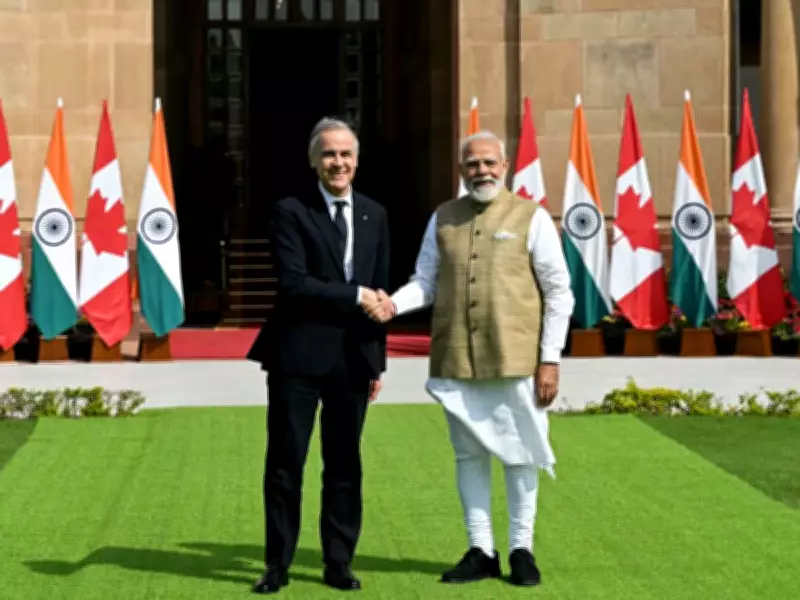
Prime Minister Mark Carney's ambitious campaign to enhance trade relations with India and China is under intense scrutiny, with critics warning that economic pursuits must not compromise Canada's national security. The potential danger lies in the government softening its stance on foreign interference to secure lucrative deals, a concern amplified by recent contradictory statements from officials.
Conflicting Messages on India's Threat Level
Prior to Carney's recent diplomatic visit to India, a senior government official anonymously informed reporters that Canada no longer views India as a security threat. This declaration marks a stark reversal from just three years ago, when former Prime Minister Justin Trudeau accused India of the extra-judicial killing of Canadian Sikh activist Hardeep Singh Nijjar, whom India designates as a terrorist.
Furthermore, it was only two years ago that Trudeau and the Royal Canadian Mounted Police (RCMP) alleged India orchestrated a broader campaign of threats and violence against Sikh activists within Canada. Despite these past allegations, RCMP Commissioner Mike Duheme stated last month on CTV's Question Period that there are currently no clandestine activities or transnational repression linked to India's government—or any foreign government—occurring in Canada.

RCMP and CSIS Provide Divergent Assessments
In a follow-up statement issued on Wednesday, the RCMP clarified that while police and the government are aware of complaints regarding intimidation and harassment against certain communities in Canada, and acknowledge that foreign states are involved in such activities, insufficient evidence exists to lay charges at this time.
Contrastingly, the Canadian Security Intelligence Service (CSIS) has consistently maintained, as reported by the National Post, that India remains one of the primary perpetrators of foreign interference and espionage against Canada. This divergence in messaging between law enforcement and intelligence agencies underscores a troubling lack of cohesion within the government's approach to security threats.
Lessons Unlearned from Foreign Interference Inquiry
The confused communication suggests that the Liberal government has failed to absorb critical lessons from the recent foreign interference inquiry. Justice Marie-Josee Hogue concluded in the inquiry that "The government has proven to be a poor communicator and insufficiently transparent when it comes to foreign interference." This assessment highlights systemic issues in how security matters are handled and disclosed to the public.
Moreover, it raises pressing questions about whether the Carney administration will treat allegations of wrongdoing by China with due seriousness. China was identified in the inquiry as the main perpetrator of electoral interference in Canada, yet Carney's government continues to pursue trade agreements with Beijing, even downplaying concerns over forced labor practices.
Balancing Trade Necessities with Security Imperatives
Both India and China vehemently deny any wrongdoing, and in the current global landscape, engaging in trade with these economic powerhouses is undeniably necessary for Canada's prosperity. However, the primary duty of any government is to safeguard its citizens, which mandates rigorous investigation into all allegations of misconduct by foreign powers.
As Carney forges ahead with his trade agenda, the imperative remains clear: economic partnerships must never undermine the foundational commitment to national security. Transparent and consistent communication from all government bodies is essential to ensure that Canada's interests are protected without compromise.






