

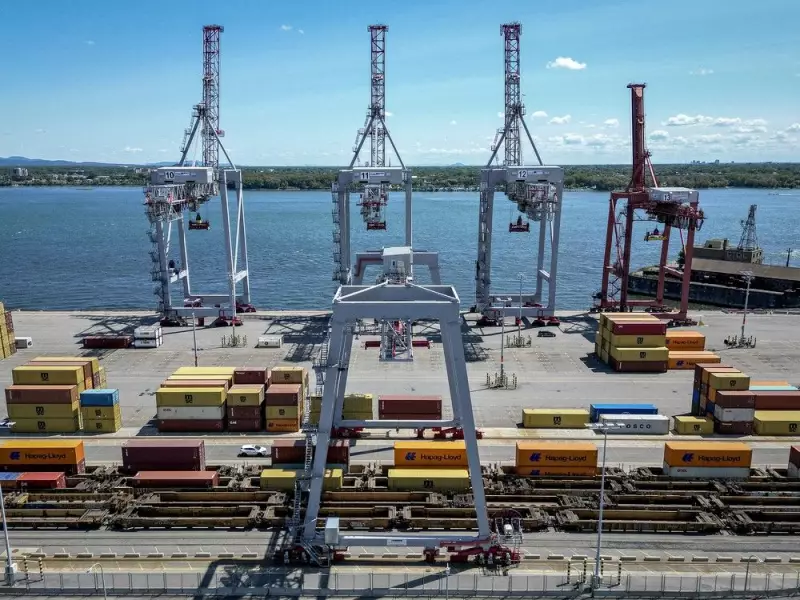
Nearly a year into Donald Trump's second presidential term and his administration's aggressive tariff regime, Quebec's economy is demonstrating notable resilience. Despite initial fears of a recession and discussions about diversifying export markets, the United States remains the destination for the vast majority of Quebec's goods, and the provincial economy continues to experience modest growth.
CUSMA Exemption Provides Critical Shield for Manufacturers
Following Trump's imposition of sweeping tariffs—first at 25 per cent and later raised to 35 per cent on Canadian imports—many Quebec businesses paused investments and scrambled to find new markets. However, a crucial exemption for goods certified under the Canada-United States-Mexico Agreement (CUSMA) has allowed a significant portion of exports to continue entering the U.S. tariff-free.
Julie White, CEO of Manufacturiers & Exportateurs du Québec, stated this exemption "has been critical" for the province's manufacturing sector, which includes roughly 13,000 firms and about 500,000 employees. "Overall, there’s still a lot of uncertainty... margins and revenues are lower than they would have been without tariffs," White acknowledged, but the protection has prevented far more severe damage.

Targeted Sectors Still Struggle Under Heavy Duties
While the CUSMA exemption offers a blanket protection for compliant goods, several of Quebec's major export industries are not covered and continue to face punishing tariffs. Steel and aluminum exports to the U.S. are subject to 50 per cent duties, while softwood lumber, already facing a 35 per cent tariff, saw an additional 10 per cent levy added in October 2025. Manufactured goods using Canadian lumber, such as kitchen cabinets, also face a 25 per cent tariff.
Charlotte Laramée, president and CEO of AluQuébec, highlighted the impact on the 1,700 mostly small- and medium-sized businesses that transform raw aluminum. These companies, employing about 30,000 people, are being forced into costly adaptations. "It hinders their competitiveness and their desire to invest, due to the prevailing uncertainty," Laramée said, noting some have had to lay off workers. Exports of aluminum to the U.S., Quebec's largest single export to its southern neighbour, declined by 16.7 per cent in the first three quarters of 2025 compared to the same period in 2024.
Economic Data and the Search for New Markets
According to the Institut de la statistique du Québec (ISQ), the province's total exports to the U.S. declined by 5.3 per cent in the first nine months of 2025. Despite increased efforts to export elsewhere, total exports to all countries were down 1.6 per cent. Nevertheless, Quebec's economy grew by about 1.1 per cent during that same period.
The data underscores the enduring dominance of the U.S. market. A full 72 per cent of Quebec’s exports from January to September 2025 went to the United States, totaling over $63 billion. While exports to the next five largest international markets—China, Japan, the Netherlands, France, and Germany—all increased, their combined value was just under $9.3 billion.
Diya Jiang, a McGill University researcher specializing in U.S.-Canada trade, explained that the effective tariff rate on Canadian exports is much lower than headline numbers suggest, thanks to CUSMA. "CUSMA still gives the best blanket protection to Canadian exports," Jiang stated.
Looking Ahead: The CUSMA Review and Political Landscape
All eyes are now on a scheduled review of CUSMA set to begin in July 2026, a process that could lead to renegotiation. Business leaders like Julie White hope the review will maintain the current exemption framework and reduce tariffs on steel, wood, and aluminum, while preserving the trilateral nature of the agreement.
The political climate will heavily influence outcomes. U.S. mid-term elections in November 2026 loom large, and analysts like Jiang suggest the U.S. may seek symbolic victories, potentially targeting energy, manufacturing, lumber, or increased access to Canada's dairy market.

Daniel Béland, director of the McGill Institute for the Study of Canada, noted the trade war has reshaped federal politics, helping the Liberals under Prime Minister Mark Carney focus on economic policy. In Quebec, where Trump's rhetoric is particularly unpopular, Béland observed an initial surge in Canadian identity, though sovereignty debates persist, especially among younger demographics.
While interprovincial trade barriers remain a frustration for some businesses, like Pit Caribou microbrewery in Gaspésie, there are signs of incremental progress. Quebec has passed legislation to recognize certifications from other provinces, a step business groups welcome as part of building a more resilient domestic economy alongside the turbulent international trade environment.





