

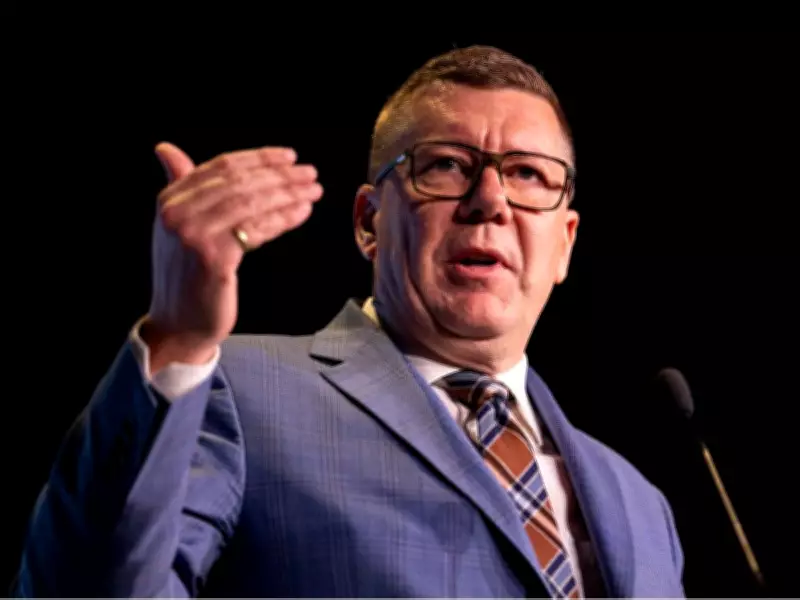
Saskatchewan Premier Scott Moe Addresses Trade and Economic Uncertainty at NSBA Luncheon
At an NSBA luncheon held in Saskatoon on Tuesday, Saskatchewan Premier Scott Moe delivered a comprehensive speech covering a wide range of topics, from international trade missions to domestic economic challenges. The event, which took place at Prairieland Park, provided a platform for Moe to outline his vision for Saskatchewan's future in an increasingly uncertain global landscape.
Affordability as a Recruitment Tool
Premier Moe highlighted that one of Saskatchewan's strongest assets in attracting new residents and businesses is the affordability of life in the province. "It doesn't seem like it every day, but it is the most affordable place in Canada to live," Moe stated. He acknowledged existing challenges but emphasized the numerous opportunities available, positioning Saskatchewan as a competitive and viable option for growth and investment.
Global Trade Initiatives and International Relations
Moe revealed his upcoming travel plans to India, where he will engage in trade discussions, while other members of his administration are set to visit countries like Brazil and the Philippines. These missions aim to strengthen international partnerships and explore new economic opportunities for Saskatchewan.

Regarding trade with China, Moe referenced recent conversations with Prime Minister Mark Carney focused on reversing tariffs on Canadian products, particularly canola. "Just to be clear, I'm not interested in the Chinese governance system being supplanted here, I'm not interested in a new world order, I just want to sell some canola seeds," Moe remarked, underscoring his pragmatic approach to trade relations.
He further suggested that expanding the availability of Saskatchewan resources, such as oil and canola, on the West coast could reignite Chinese interest and restore some of the province's trade volumes.
Indigenous Relations and Economic Development
Moe also touched on the importance of Indigenous relations and the duty to consult when developing land in Saskatchewan. He praised companies like Cameco for investing in local communities, creating jobs, and contributing to the well-being of northern and Indigenous populations. This approach, he argued, fosters sustainable development and mutual benefit.
Data Centres vs. Traditional Industries
When questioned about the potential for developing data centres in Saskatchewan, Moe expressed a preference for traditional industries like potash mining. "A traditional data centre will employ four people: two electricians and two janitors ... I'll take a potash mine every day of the week," he said, highlighting job creation as a key priority.
However, Moe also acknowledged the value of emerging technologies, noting his interest in the careers that businesses bring, as well as advancements in artificial intelligence and cybersecurity. He emphasized Saskatchewan's role in contributing to Canada's data sovereignty, balancing traditional economic strengths with modern technological opportunities.
Impact of U.S. Tariffs and Post-Trump America
Premier Moe addressed the recent announcement by United States President Donald Trump regarding immediate 15% global tariffs, following a Supreme Court ruling that deemed previous emergency tariffs unlawful. "Those comments are causing continued uncertainty in global markets," Moe observed, noting that such instability leads to lower revenues for Saskatchewan-based businesses.
He further explained that Trump's remarks are affecting government bottom lines, creating economic pressures that ripple across borders. Despite these challenges, Moe stressed that Canadians must recognize America as their largest trading partner in a post-Trump era, underscoring the enduring importance of U.S.-Canada relations for Saskatchewan's economic future.
In conclusion, Premier Scott Moe's speech at the NSBA luncheon painted a picture of a province navigating complex global dynamics while leveraging its strengths in affordability, traditional industries, and strategic international partnerships. His remarks reflect a balanced approach to economic development, prioritizing both immediate opportunities and long-term stability in an ever-changing world.






