

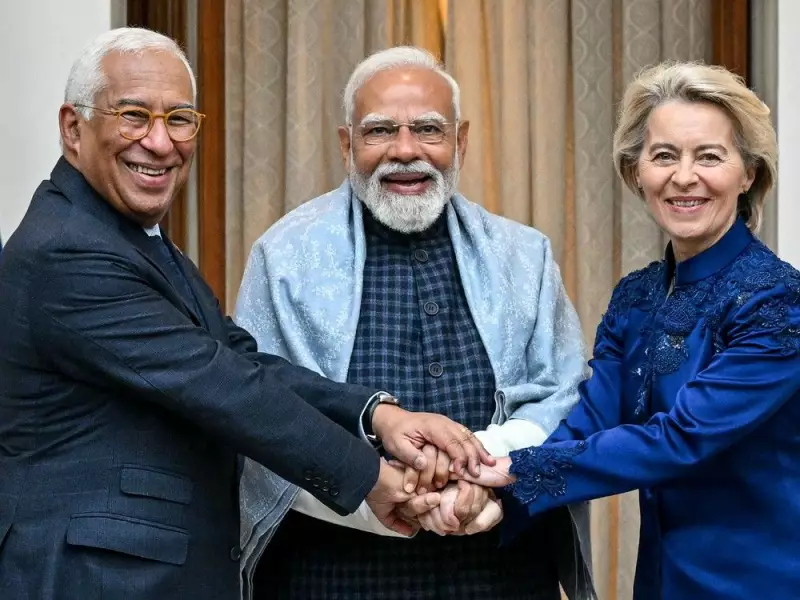
EU and India Finalize Historic Free Trade Agreement After Decades of Negotiations
The European Union and India have successfully concluded what officials are calling a "historic" free trade agreement, marking a significant milestone in international economic relations after nearly two decades of complex negotiations. This landmark pact represents India's most ambitious trade agreement to date and establishes a formidable economic partnership between two of the world's largest markets.
A Strategic Response to Global Economic Shifts
The agreement comes at a pivotal moment in global trade dynamics, with both parties seeking to reduce their economic dependence on the United States and China. European Commission President Ursula von der Leyen, who traveled to New Delhi to finalize the deal alongside European Council President Antonio Costa, declared this "the mother of all deals" in a social media announcement.
"We have created a free trade zone of two billion people, with both sides set to benefit," von der Leyen stated emphatically. "This is only the beginning. We will grow our strategic relationship to be even stronger."

Comprehensive Market Access and Economic Benefits
The comprehensive agreement includes substantial tariff reductions that promise to transform trade flows between the two economic powers:
- India has committed to eliminating or reducing tariffs on 96.6% of EU goods exports, with projections suggesting this could double EU exports to India by 2032
- The European Union will reciprocate by removing or lowering tariffs on 99.5% of Indian imports over a seven-year implementation period
- New Delhi has agreed to allow up to 250,000 European-made vehicles to enter India at preferential duty rates—a quota more than six times larger than in recent trade agreements
Strengthening India's Economic Position
Indian Prime Minister Narendra Modi hailed the agreement as a transformative development for India's economy, emphasizing its potential to strengthen manufacturing and services sectors while boosting investor confidence in Asia's third-largest economy.
"India has completed its biggest and most historic free trade agreement," Modi announced during a joint press briefing in New Delhi. "This historic agreement will make it easier for our farmers and small businesses to reach the European markets."
Addressing Global Trade Challenges
The timing of this agreement reflects strategic calculations by both parties in response to shifting global alignments. The European Union, despite historical trade policy disagreements with India, is actively working to diversify its economic partnerships beyond traditional reliance on the United States and China.
For India, the agreement represents a concerted effort to move beyond its protectionist reputation while navigating complex international relationships. The pact provides Indian exporters with competitive advantages in sectors particularly affected by recent U.S. tariff policies, including:
- Apparel and textiles
- Gems and jewelry
- Footwear and leather goods
Additional Provisions and Strategic Considerations
Beyond traditional trade elements, the agreement includes several noteworthy provisions:
- The European Union has offered binding commitments on student mobility and post-study visas, facilitating educational exchange between the regions
- Brussels has extended concessions across 144 services sectors, expanding opportunities beyond goods trade
- India has strategically protected its politically sensitive dairy sector by keeping it outside the agreement's scope
This landmark agreement establishes a new framework for EU-India economic cooperation that promises to reshape trade patterns, strengthen strategic partnerships, and create new opportunities for businesses and consumers across both regions. As global economic dynamics continue to evolve, this partnership positions both the European Union and India for enhanced economic resilience and growth in the coming decade.






