

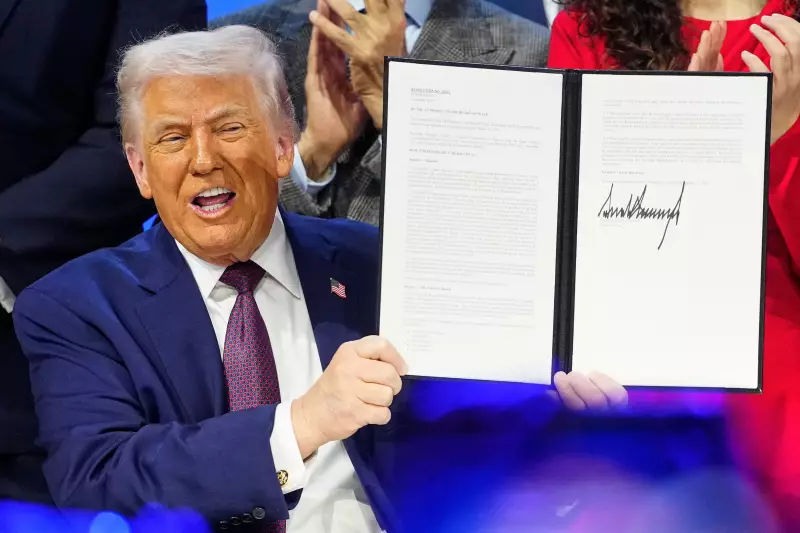
Global Trade Dynamics Shift at Davos Amid Trump's Tariff Announcements
The annual World Economic Forum in Davos, Switzerland, has become the stage for significant shifts in international trade policy, as former U.S. President Donald Trump outlined a new framework for tariffs and potential agreements. The developments are prompting nations worldwide to reassess their economic strategies and bilateral relationships.
Trump's Tariff Framework and Greenland Proposal
During his address at the prestigious forum, Trump announced what he described as a "framework" for future trade arrangements, specifically mentioning a potential deal concerning Greenland. He emphasized that this framework would not include tariffs on European Union countries, marking a notable departure from previous protectionist rhetoric. "It puts everybody in a really good position," Trump stated regarding the proposed Greenland arrangement.
The former president explicitly ruled out military action to acquire Greenland, stating "I won't do that" and assuring there would be "no military invasion in the near future." Danish politicians responded cautiously, with one member of parliament noting the proposal "sounds like a good development" while awaiting further details.

Targeted Comments Toward Canada and Prime Minister Carney
Trump's speech included pointed remarks directed at Canada and Prime Minister Mark Carney, who had delivered his own address at the forum earlier. "Canada lives because of the United States - remember that," Trump declared, adding that "Canada should be grateful" for American support. These comments have raised questions about potential impacts on the Canada-United States-Mexico Agreement (CUSMA) and broader North American trade relations.
Analysts are examining whether Carney's World Economic Forum speech might influence Trump's approach to continental trade agreements. The former president's criticism of Carney's remarks suggests heightened sensitivity to Canadian positions on international economic matters.
Broader Geopolitical and Trade Implications
Beyond specific bilateral relationships, Trump's Davos address touched on multiple geopolitical themes. He reiterated his administration's stance on immigration, asserting that "the west cannot mass import foreign cultures," while also emphasizing American military strength with the claim that "without us right now you'd all be speaking German."
NATO officials sought to reassure the former president during the forum, with the alliance's chief confirming that European members would defend the United States if attacked. This exchange highlights ongoing discussions about burden-sharing within the transatlantic partnership.
Market Reactions and Agricultural Concerns
Financial markets responded positively to Trump's tariff announcements, with both Canadian and American indices rising following his speech. However, agricultural stakeholders expressed continued uncertainty, particularly regarding canola tariffs. Canadian farmers emphasized they "really need to see all tariffs removed" to achieve genuine trade stability.
The auto sector has called for a "Team Canada" approach following China's electric vehicle trade deal, warning that "we are in the fight of our lives" to maintain competitiveness. This sentiment reflects broader concerns about how shifting global trade patterns will affect key Canadian industries.
Domestic Policy Intersections
While international trade dominated discussions at Davos, domestic Canadian issues continue to evolve. Prime Minister Carney's cabinet is meeting in Quebec City to discuss economic and security matters, while First Nations leaders are challenging the federal government over pipeline agreements that allegedly neglect water protection commitments.
Health Canada has issued warnings about unauthorized versions of diabetes medications Ozempic and Mounjaro, and recalled organic chia seeds due to salmonella concerns. These domestic regulatory actions occur alongside the international trade developments discussed at Davos.

The convergence of these issues illustrates how global economic policies increasingly intersect with domestic concerns, from agricultural livelihoods to public health protections. As nations adjust to the emerging trade landscape outlined at Davos, the coming months will reveal how these frameworks translate into concrete policies affecting businesses, consumers, and international relations.





