

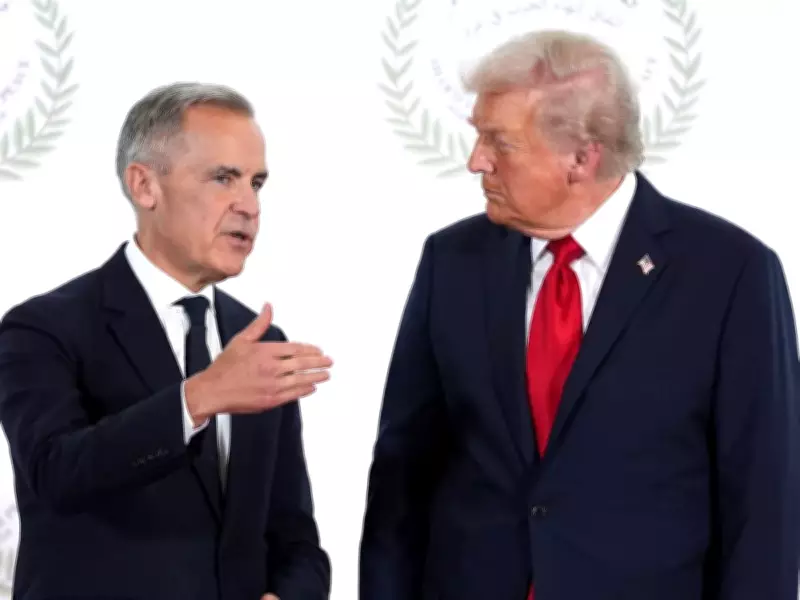
Carney's Davos Remarks Trigger Trump's Tariff Threat Against Canada
Prime Minister Mark Carney has recklessly provoked President Donald Trump with inflammatory rhetoric, leading to a hyperbolic overreaction that threatens Canada's economic stability. The U.S. president responded by threatening to impose a 100% tariff on all goods and services exported from Canada to the United States, a move that would have devastating consequences if implemented.
Economic Catastrophe Looming for Canadian Economy
Given that Canada-U.S. trade totals approximately $910 billion annually, such a prohibitive tariff would push Canada into a severe recession or even depression. The economic impact would be catastrophic, resulting in:
- Millions of lost jobs across multiple sectors
- A plummeting Canadian dollar
- Exacerbated inflation pressures
- Significant capital flight from Canadian markets
- Compromised national security through economic vulnerability
Although Trump's threats should be taken seriously rather than literally, Carney's decision to indulge his ego for domestic political purposes represents irresponsible leadership at a critical moment.

Strategic Miscalculation in International Diplomacy
Carney's communications strategy appears designed to play to multiple audiences simultaneously. During his speech at the World Economic Forum in Davos, he received a standing ovation from global elites committed to a liberal rules-based international order. Simultaneously, he was appealing to a domestic Canadian audience, where over three-quarters of citizens hold negative opinions of Trump and appreciate politicians who confront what they perceive as bullying behavior.
The prime minister's characterization of China as a more predictable partner than the United States represented a particularly gratuitous insult that was certain to irritate American officials. U.S. Commerce Secretary Howard Lutnick dismissed the comments as mere "political noise," but the damage to diplomatic relations had already been done.
CUSMA Negotiations in Jeopardy
While the threatened 100% tariff is unlikely to materialize due to its equally damaging impact on the U.S. economy, Canada's bargaining position has been severely compromised ahead of crucial CUSMA free trade negotiations scheduled for later this year. The diplomatic fallout makes it more likely that the United States will impose some form of punishing tariff, even if less severe than the initial threat.
Carney exaggerated the significance of Canada's recent trade agreement with China, calling it a strategic partnership and declaring that the "old relationship" with the United States based on deep economic and military integration is "over." This political hyperbole stands in stark contrast to Carney's own pre-election characterization of China as Canada's "biggest security threat."
Domestic Political Calculations and National Interest
Rumors suggest Carney may be considering a snap election to secure his coveted parliamentary majority. If this political calculation is driving his communications strategy, it represents a cynical ploy that jeopardizes the national interest during a period of exceptional economic vulnerability. The strategy could backfire dramatically if trade talks are suspended and the Canadian economy suffers further damage from heightened uncertainty.
Canadian voters who believed they were electing a competent financial manager may grow disillusioned if Carney fails to deliver on his campaign promise to negotiate effectively with the U.S. president. His analytical approach and reassuring rhetoric will wear thin if tangible results fail to materialize, potentially leading to the conclusion that he represents yet another Liberal leader who fails to deliver on economic promises.
The prime minister's reference to Trump as a hegemon without explicitly naming him represents an unhelpful diplomatic tactic when dealing with a political powerhouse known for striking out when provoked. Carney's suggestion that middle powers should coalesce against more powerful nations seems designed to incite rather than persuade a crucial trading partner to negotiate in good faith.






