

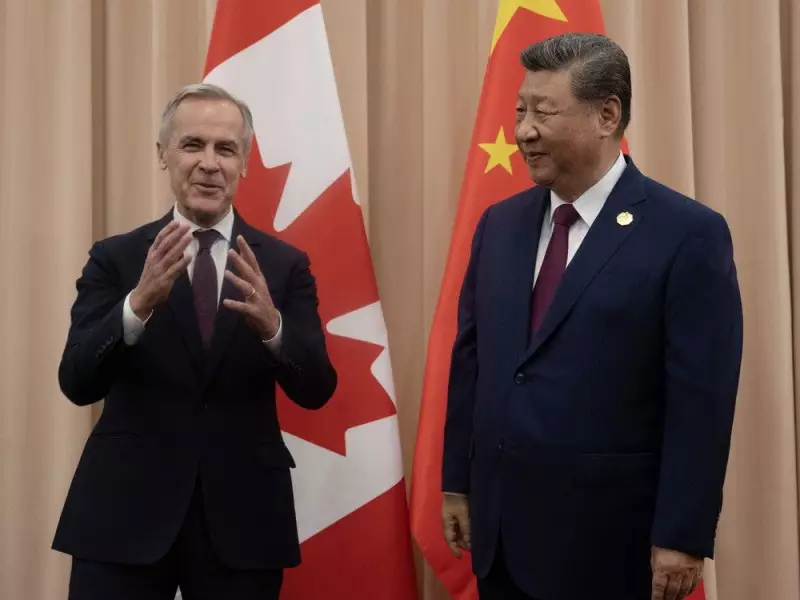
Prime Minister Mark Carney embarked on a pivotal journey to Beijing this morning, marking the first visit by a Canadian leader to China since 2017. The high-stakes trip, described by officials as "consequential and historic," aims to reset a diplomatic relationship that has been frozen for years and tackle severe trade barriers costing Canadian exporters billions.
A Mission to Mend Fences and Markets
The Liberal government views this global tour, which includes China as a key stop, as a critical opportunity to lay a stronger foundation for future ties with Canada's second-largest trading partner. A core component of Carney's economic strategy is to double non-U.S. exports, making a functional relationship with the Asian economic powerhouse essential.
Senior government officials briefing reporters emphasized the trip's goal is not only to revive Chinese investment in sectors deemed "safe" by Ottawa but to dismantle existing trade obstacles. Foremost among these are crippling Chinese tariffs of 76 to 100 per cent on Canadian canola and 25 per cent on pork and seafood, which have effectively halted exports in these categories.

The Tariff Battle and Its Impact
"All canola exports, canola seed, oil and meal are all stopped because of the tariffs. They're prohibitive," stated Rick White, President & CEO of the Canadian Canola Growers Association. These Chinese measures were implemented as retaliation for Canadian policies, including 100 per cent border levies on Chinese electric vehicles and a 25 per cent import tax on Chinese steel and aluminium.
During his time in the Chinese capital, Carney's schedule includes high-level meetings with Premier Li Qiang, National People's Congress Chairman Zhao Leji, and President Xi Jinping. The objective is to smooth over tensions that have defined bilateral relations since the diplomatic deep freeze of 2018.
Navigating a Complex Diplomatic Legacy
The current frost stems from the 2018 arrest of Huawei executive Meng Wanzhou by Canadian authorities on a U.S. extradition request. China's response was the detention of two Canadian citizens, Michael Kovrig and Michael Spavor, for nearly three years. While the "Two Michaels" have been released, the underlying distrust persists.
Carney's push to reignite trade is met with significant concern among critics and Asia-Pacific watchers, who point to China's record of using economic coercion for political ends. In an October commentary following a Carney-Xi meeting in South Korea, Michael Kovrig warned, "While the Chinese Communist Party (CCP) and its envoys have altered their tone, their hostile intentions and harmful policies remain unchanged."
Kovrig further suggested China's goals are to "enhance economic ties selectively to create dependence and offload overproduction, while sowing political divisions, both among Canadians and between Canada and its allies."
Domestically, the trip is also being closely monitored by Canada's automotive sector. A key question is whether Carney will consider reducing tariffs on Chinese EVs or even permit Chinese automakers to establish manufacturing operations in Ontario as a potential olive branch to ease broader trade tensions.
As Prime Minister Carney navigates this delicate diplomatic and economic terrain, the rewards of a successful reset are substantial for Canadian exporters. However, the risks of compromising on national security or allied relationships in the pursuit of trade loom equally large, making this one of his government's most challenging foreign policy tests to date.






