

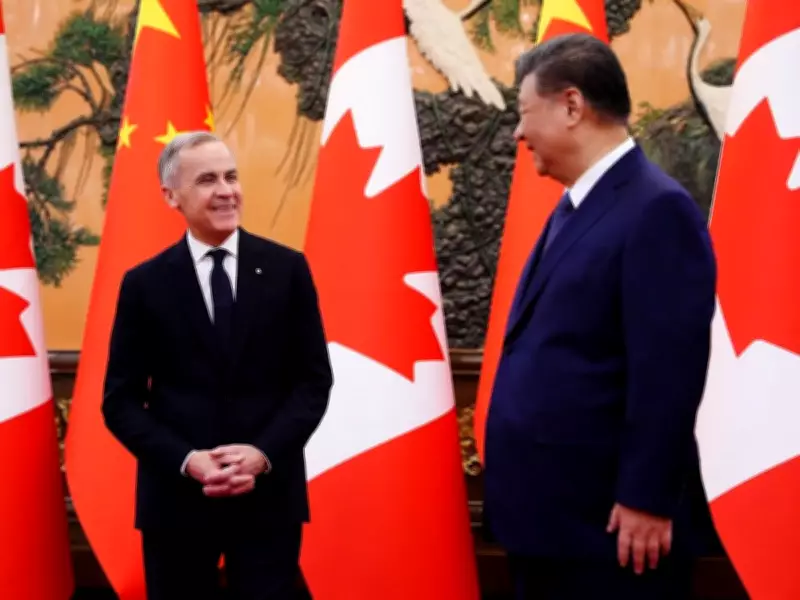
Carney's China Engagement Strategy Faces Taiwan Invasion Threat
Conservative Leader Pierre Poilievre has expressed significant concerns about Prime Minister Mark Carney's "strategic partnership" with China, warning that what has been presented as constructive engagement could rapidly deteriorate into a geopolitical crisis. During his party's convention speech in Calgary, Poilievre highlighted the inherent risks in Canada's deepening economic ties with Beijing, particularly as tensions surrounding Taiwan continue to escalate.
The Diversification Dilemma
Carney's administration has pursued what it calls "strategic autonomy" through building relationships with middle powers and alternative trading partners, aiming to reduce Canada's traditional overreliance on the United States. This diversification strategy appears logical on paper, representing a calculated Plan B to hedge against uncertainty in North American markets. The recent agreement allowing 49,000 Chinese electric vehicles into Canada in exchange for tariff relief on canola exemplifies this approach, though Conservative critics have questioned its scope and implications.
However, the fundamental problem lies in China's unpredictable geopolitical behavior, particularly regarding Taiwan, where 92 percent of inhabitants oppose annexation by Beijing. While some Western conservatives have welcomed the economic benefits of engagement, the Conservative leader recognizes that Canada must diversify its markets while remaining cautious about potential geopolitical fallout.

Geopolitical Warning Signs Flash Red
According to Dr. Yun Sun, director of the China program at the Stimson Center, a prominent American foreign affairs think tank, "the warning signs are flashing red" in Beijing regarding Taiwan. Speaking on the Decoding Geopolitics podcast, Dr. Sun warned that Western nations are dangerously underestimating the risk of a Chinese invasion of Taiwan, potentially as soon as this year.
"The West is underestimating the risk of a Chinese invasion of Taiwan as early as this year," Dr. Sun emphasized, noting that Chinese President Xi Jinping appears to have abandoned the notion that time favors China's position. Instead, Xi perceives current geopolitical conditions as creating a "perfect storm" that could provide cover for military action against Taiwan.
Perfect Storm for Conflict
Several converging factors have made military action increasingly favorable from Beijing's perspective:
- A U.S. administration perceived as "at best indifferent" about Taiwan's future
- Deteriorating Western alliances and coordination
- Washington's expressed preference for non-intervention in foreign conflicts
- A U.S. national security strategy prioritizing Western hemisphere concerns
These developments have reportedly been interpreted by Chinese leadership as signaling that the Western Pacific now falls within Beijing's sphere of influence. China remains tenaciously committed to pursuing military options regarding Taiwan, with geopolitical circumstances creating what some experts consider an unprecedented window of opportunity for action.
Political and Economic Consequences
For Prime Minister Carney, the potential for rapid deterioration in Canada-China relations presents both political and economic challenges. What has been portrayed as "constructive, pragmatic engagement" could quickly unravel if Beijing follows through on invasion threats, providing Poilievre with substantial grounds to question the government's strategic judgment.
The Conservative leader's dilemma is particularly acute because, while domestic political concerns would naturally arise from such a crisis, they would pale in comparison to the broader geopolitical and economic consequences for Canada. Attempting to offset potential trade losses with the United States by strengthening ties with China could backfire spectacularly if military conflict erupts over Taiwan, potentially isolating Canada diplomatically and economically.

Even as Poilievre acknowledges the necessity of market diversification away from American dependence, his wariness about the China partnership reflects deeper concerns about geopolitical stability and long-term strategic planning. The limited scope of current agreements provides some protection, but experts warn that broader engagement carries significant risks that Canada may be underestimating as warning signals intensify from Beijing.





