

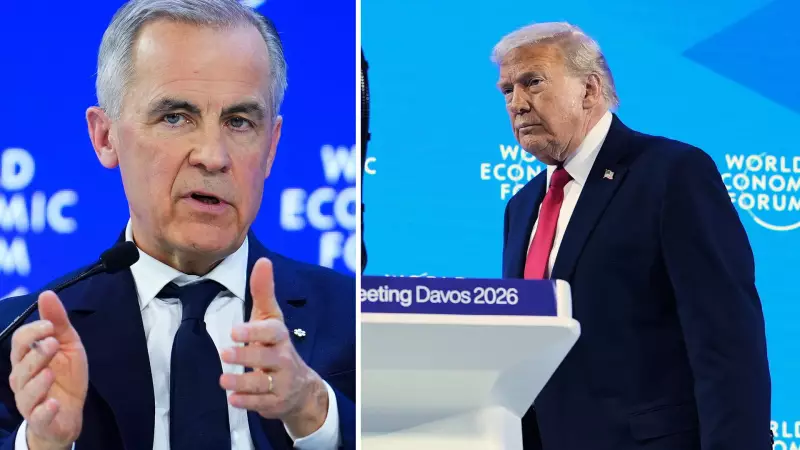
Carney and Trump's Sharp Exchange at Davos Ignites Alberta Trade and Sovereignty Debate
The global stage at the World Economic Forum in Davos became the setting for a pointed diplomatic exchange this week, as Prime Minister Mark Carney's address and a subsequent response from U.S. President Donald Trump have reverberated strongly back home in Alberta. The verbal sparring has sharpened ongoing debates within the province concerning economic sovereignty and the future of critical trade relationships.
A Speech and a Swift Rebuttal
Prime Minister Carney's keynote speech at the prestigious international forum outlined a vision for Canada's role in what he described as an evolving global order. While the full text addressed multiple geopolitical and economic themes, certain passages regarding trade independence and national policy priorities have drawn particular attention. Shortly thereafter, President Trump delivered remarks that included a direct warning to the Canadian leader, stating "Remember that, Mark" in a context that analysts interpret as relating to trade negotiations and bilateral relations.
Alberta's Reaction and Broader Implications
The exchange has not occurred in a vacuum. In Alberta, political and business leaders are actively parsing the implications for the province's energy sector, agricultural exports, and overall economic relationship with its southern neighbor. The timing is significant, coming amidst ongoing discussions about provincial autonomy and the federal government's trade negotiation strategies. Some Alberta commentators have framed Carney's Davos comments as a challenge to long-standing trade dependencies, while others view Trump's response as a typical negotiation posture from the U.S. administration.

This diplomatic friction occurs against a backdrop of other significant trade developments. Notably, Ontario Premier Doug Ford has publicly urged Canadians to boycott Chinese electric vehicles that are expected to enter the Canadian market as part of broader trade agreements championed by the federal government. Meanwhile, British Columbia Premier David Eby has stated that his province will play a key role in the new global framework described by Prime Minister Carney, suggesting a coordinated but potentially complex interprovincial approach to international commerce.
The Domestic Political Landscape
The Davos incident has quickly filtered into domestic political discourse. Prime Minister Carney has called a meeting of key ministers in Quebec City for Thursday, a move seen by observers as a direct response to the escalating situation. Furthermore, former Alberta justice ministers have recently criticized the provincial government for what they deem "unacceptable" conduct in unrelated matters, indicating a tense political environment where federal-provincial relations are under constant scrutiny.
On the economic front, Canadian and U.S. financial markets showed resilience, rising after President Trump announced a change of course regarding proposed tariffs linked to a framework deal concerning Greenland. This market reaction suggests that investors are weighing the sharp rhetoric against concrete policy actions, though the long-term trade environment remains uncertain.
The Carney-Trump exchange at Davos serves as a potent reminder of how quickly international diplomacy can influence domestic policy debates. For Alberta, a province whose economy is deeply intertwined with international trade, the words exchanged in Switzerland may well shape political and economic discussions for months to come.






