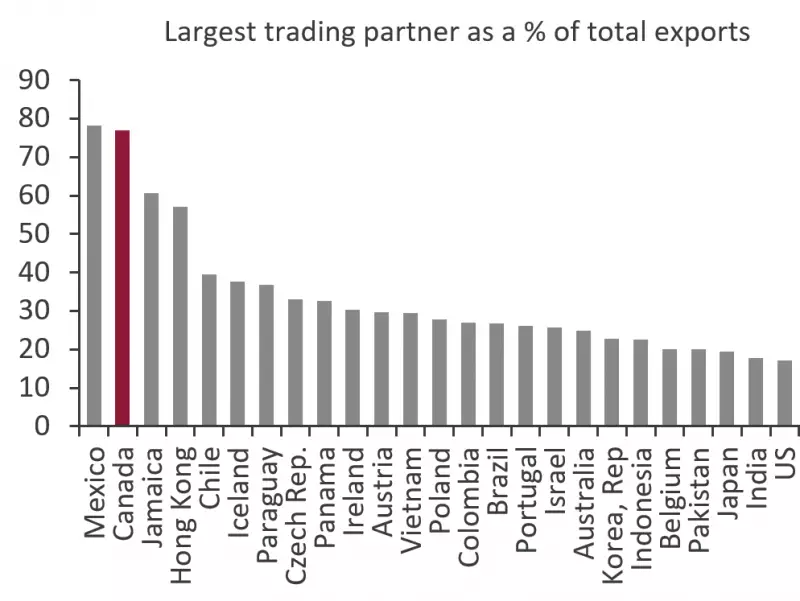
In a notable political development, the Bloc Québécois has emerged as a vocal critic of Prime Minister Mark Carney's ambitious economic strategy to pivot Canadian trade away from its dominant reliance on the United States. This stance marks a significant shift for a party traditionally focused on Quebec sovereignty rather than federal international trade policy.
A Party's Pragmatic Turn on Trade
Since the April federal election, the Bloc has positioned itself firmly against the government's plan. Leader Yves-François Blanchet has been particularly outspoken. In September, he criticized Carney for not spending sufficient time in Washington, D.C., and for neglecting what he termed Canada's "privileged and close relationship" with its southern neighbor.
The criticism intensified in late November following a contentious G20 summit press briefing. When asked about his last contact with U.S. President Donald Trump, Carney replied, "who cares?" He added, "I'll speak to him again when it matters." Blanchet swiftly responded on social media, stating that such remarks were "not helping to re-establish necessary relations with the United States."

This opposition is notably pragmatic, rooted in economic reality rather than political affinity. Polls indicate Bloc supporters are among the most hostile to President Trump and the U.S. generally, with a recent Leger poll finding 47% view it as an "enemy country." Yet, the party argues that no alternative market can replace the colossal U.S. economy for Canadian exports.
The Core of the Dispute: An Unreplaceable Market
The political clash stems from the fundamental direction of Canadian trade policy following a sudden breakdown in U.S.-Canada negotiations in late October. Instead of seeking reconciliation, Carney has doubled down on his vision to find new global buyers for Canadian goods.
This strategy was crystallized in a late October speech promoting the 2025 federal budget. In a striking reframing, Carney described Canada's geographic and economic closeness to the United States as a "vulnerability." He argued, "Many of our former strengths, based on close ties to America, have become our vulnerabilities." He concluded with a defiant note of self-reliance: "We can give ourselves far more than others could ever take from us."
The Bloc Québécois counters this optimism with hard data. They emphasize that Canada's prosperity is inextricably linked to the United States, which remains the most powerful economy in human history and the destination for the overwhelming majority of Canadian exports. Their central argument is that any plan to significantly diversify trade away from this single market is, at best, unrealistic and, at worst, economically dangerous.
Implications for Canada's Economic Future
This debate highlights a critical crossroads for Canadian economic policy. On one side is a government advocating for strategic diversification to mitigate over-dependence on a single, sometimes unpredictable, partner. On the other is a pragmatic argument, now voiced strongly by the Bloc Québécois, that the unique scale and integration of the U.S.-Canada trade relationship cannot be replicated.
The dispute goes beyond partisan politics, touching on the core of Canada's economic identity. It raises essential questions about risk management, global positioning, and whether the benefits of deep integration with the U.S. outweigh the perceived vulnerabilities. As this policy unfolds, the Bloc's unexpected role as a defender of the U.S. trade relationship adds a complex new layer to Canada's parliamentary and economic landscape.
The outcome of this ideological clash will significantly influence Canada's trade negotiations, diplomatic engagements, and long-term economic resilience for years to come.