

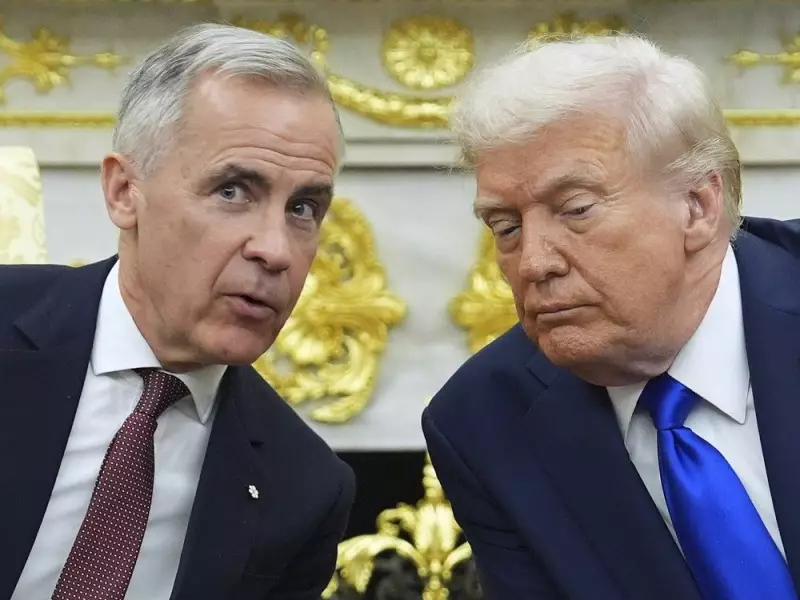
In a poignant public letter, an American columnist has directly asked Canadians a painful question: 'Can we still be friends?' The query comes amid what observers describe as the most significant chill in modern U.S.-Canada relations, driven by the policies and rhetoric of U.S. President Donald Trump.
A Friendship Under Strain
The columnist, Randy Essex, frames part of the upheaval since Trump's return to power as 'confounding attacks on our very good neighbor, trading partner and ally.' These attacks have included the imposition of tariffs, threats of more, and public statements where Trump has suggested Canada should be a U.S. state, accused the country of ripping off Americans, and labeled it a source of fentanyl.
Essex is quick to clarify that this sentiment is not broadly shared by the American public. Citing Pew Research Center polling from spring 2025, he notes that 74 per cent of Americans still hold a favorable view of Canada, despite months of presidential criticism. The bewilderment over the administration's approach is a feeling shared across the political aisle.

Bipartisan Criticism from the U.S.
James Blanchard, a former Michigan congressman, governor, and U.S. ambassador to Canada from 1993-96, captured the confusion, asking, 'What did Canadians do to us?' Blanchard, a Democrat, stated that relations are currently 'the worst in modern history.'
This perspective is echoed by Republican voices. Don Bacon, a Republican congressman from Nebraska and a retired U.S. Air Force brigadier general, did not mince words. 'The administration’s behavior towards Canada has been self-destructive and foolish,' Bacon told Essex.
Bacon criticized specific actions, including 'making threats, even if in jest, about invading Canada' and 'calling Canada’s prime minister a 51st governor.' He also highlighted the counterproductive nature of 'putting tariffs on Canada when we have a trade agreement.' His conclusion was stark: 'Canadians are rightfully mad at us because of the president.'
The Tangible Fallout and a Cautious Future
The diplomatic frost has had real-world consequences. The ongoing trade war has led to millions fewer Canadian trips across the border in 2025, as noted in the article. A photo from March 2025 shows Canadian and American flags flying along the Windsor riverfront near the Ambassador Bridge, a symbolic location for cross-border trade now shadowed by tension.
Looking ahead, former Ambassador Blanchard expressed a tempered optimism. He believes the friendship can be repaired by the next U.S. president, but only if that leader dedicates significant time to the effort. However, he warns that, like other institutions Trump has disrupted, 'things won’t ever be the same.'
'I’m worried the Canadian people and their leaders will never entirely trust us again,' Blanchard said. He pointed out that even if a future president seeks to normalize ties, allies will remain wary of 'our voters and our culture,' signaling a potential long-term erosion of faith in American consistency on the world stage.
The column serves as both an apology from one American's perspective and a warning. It underscores that while the current damage is viewed as emanating from one administration, the repair work required to restore the special relationship will be substantial and cannot be taken for granted.






