A prolonged closure of the Strait of Hormuz poses the single greatest threat to global energy markets in decades, according to a new Horizons report from Wood Mackenzie titled Strait Talking: Iran War Scenarios and the Future of Energy. More than 11 million barrels per day (b/d) of Gulf crude and condensate production is currently curtailed. Meanwhile, over 80 million tonnes per annum (Mtpa) of LNG supply, equivalent to around 20% of global supply, remains inaccessible to global markets.
Three Scenarios Outlined
In its new report, Wood Mackenzie has shared three distinct scenarios: Quick Peace, Summer Settlement, and Extended Disruption. Each scenario offers a different timeline for ending the conflict and reopening the Strait and assesses the potential impact on oil and gas supply, prices, energy demand, and the broader global economy.
Quick Peace
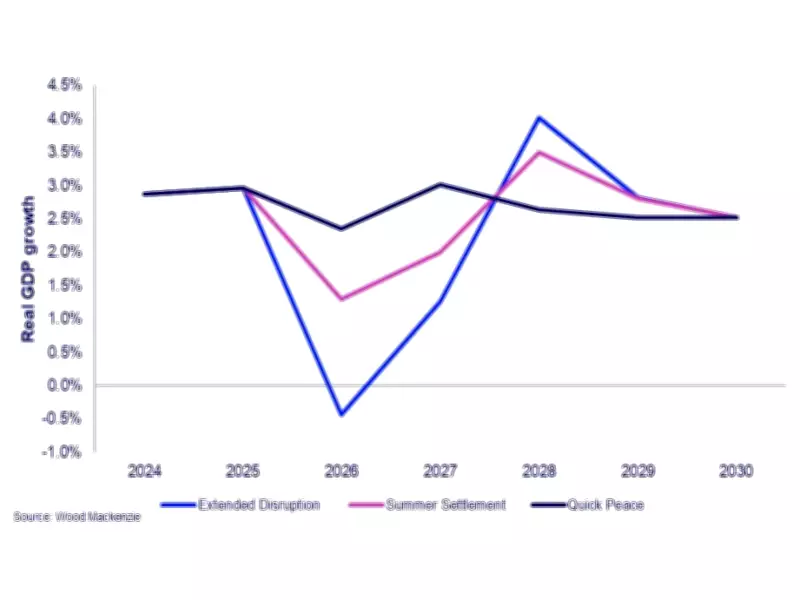
Under the most optimistic Quick Peace scenario, a workable peace agreement is reached in the near term, and the Strait reopens by June. The global economy broadly returns to its pre-war trajectory by Q4 2026. Crude prices fall sharply following a deal, with Dated Brent easing to around US$80/bbl by end-2026 and declining further to US$65/bbl in 2027 as the oil market returns to oversupply. Global GDP growth slows from 3% in 2025 to 2.3% in 2026, with a recession limited to the Middle East.

Summer Settlement
The Summer Settlement scenario assumes the ceasefire holds but negotiations extend into late summer, with the Strait remaining largely closed until September. Oil and LNG supply shortages persist through Q3 2026, driving a shallow global recession in H2 2026. Global GDP growth falls below 2% in 2026, resulting in modest yet permanent economic scarring compared to the pre-war baseline.
Extended Disruption
Under the most severe scenario, the Strait remains largely closed through the end of 2026, with recurring tensions triggering periods of renewed conflict and sustained supply disruption. Wood Mackenzie’s analysis indicates that Brent crude prices could approach US$200/bbl by end-2026, despite global oil demand falling by 6 million b/d year-on-year in H2 2026. More than 11 million b/d of crude and condensate production remains shut in, and global oil inventories continue to decline. Diesel and jet fuel prices could rise towards US$300/bbl in major refining centres by year end. The global economy could contract by as much as 0.4% in 2026, marking the third global recession this century, with significant economic scarring. Oil and gas importing countries could intensify efforts to reduce their import dependence by aggressively pursuing faster electrification.
“The Strait of Hormuz is the most critical chokepoint in global energy markets, and a prolonged closure would become far more than an energy crisis,” said Peter Martin, head of economics at Wood Mackenzie. “The longer disruption persists, the greater the impact on energy prices, industrial activity, trade flows and global economic growth.”