Russia and Iran Slash Oil Prices in Intensifying Competition for Chinese Market
Russian and Iranian oil producers are offering increasingly steep discounts as they vie for the same limited pool of Chinese buyers, following India's significant retreat from purchases. This competitive dynamic has triggered a price war between the two major exporters, with unsold crude accumulating in Asian waters.
India's Import Reduction Sparks Market Shift
According to analysis from Rystad Energy, India's imports from Russia could plummet by approximately 40 percent from January levels to around 600,000 barrels per day. This substantial reduction has redirected displaced cargoes eastward, where Russian suppliers are now directly competing with Iranian producers who have traditionally been favored by China's private refiners.
Deepening Discounts on Key Crude Grades
Traders familiar with the market report that Russia's Urals grade is currently selling at approximately US$12 per barrel below ICE Brent, representing a significant widening from the US$10 discount observed last month. Meanwhile, Iranian Light crude is trading at discounts of up to US$11 below the global benchmark, expanding from the US$8 to US$9 range recorded in December. These traders requested anonymity as they are not authorized to speak with media outlets.

Limited Capacity of Chinese Private Refiners
The independent Chinese refiners, commonly referred to as teapots, have historically functioned as the oil market's pressure valve by absorbing barrels rejected by other buyers. However, their capacity remains constrained as they account for only about one-quarter of China's total processing capacity and operate under government-imposed import quotas.
"Chinese private refiners cannot take in much more as their capacity is likely maxed out," explained Jianan Sun, an analyst at Energy Aspects, noting that sanctioned barrels are accumulating in both onshore and offshore storage facilities.
Growing Inventories in Asian Waters
With China unable to fully absorb the displaced crude, unsold oil is accumulating in Asian maritime regions. Data intelligence firm Kpler estimates there are now nearly 48 million barrels of Iranian oil at sea, a substantial increase from approximately 33 million barrels in early February. Most of this buildup is occurring in the Yellow Sea and Singapore Strait. Concurrently, around 9.5 million barrels of Russian oil are sitting in Asian waters.
Diverging Export Fortunes
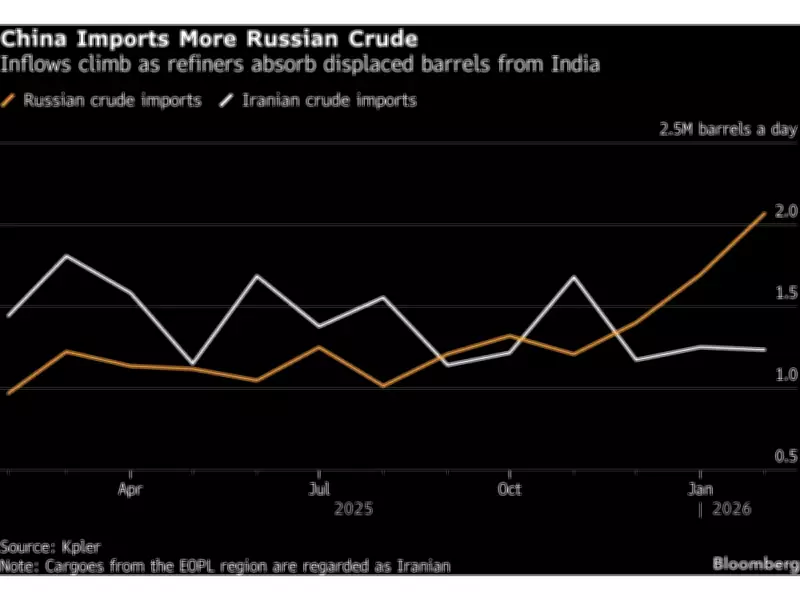
Recent shipping data reveals contrasting trajectories for Russian and Iranian exports to China. Deliveries of Russian oil to Chinese ports surged to 2.09 million barrels per day during the first 18 days of February, according to vessel-tracking data compiled by Bloomberg. This represents a roughly 20 percent increase from January and approximately a 50 percent jump from December levels.
In contrast, Iran has exported about 1.2 million barrels per day to China so far this year, marking a decline of around 12 percent compared to the same period last year, according to Kpler's estimates.
Geopolitical Factors Influencing Market Dynamics
Several geopolitical considerations are shaping this competitive landscape. Russia has already been compelled to curtail output, reducing funds available for its conflict in Ukraine. Meanwhile, Iran is attempting to maximize oil shipments as it prepares for potential military action by the United States.
Lin Ye, vice president of oil markets at Rystad Energy, noted that Russian barrels currently present "a relatively lower level of risk" for Chinese buyers compared to Iranian cargoes, partly due to optimism regarding a potential ceasefire in Ukraine.
The situation remains fluid, with the possibility of U.S. military action against Iran potentially disrupting exports if oil facilities are targeted or transit through the Strait of Hormuz is impeded. The United States has deployed substantial military assets to the Middle East, creating additional uncertainty in an already volatile market.