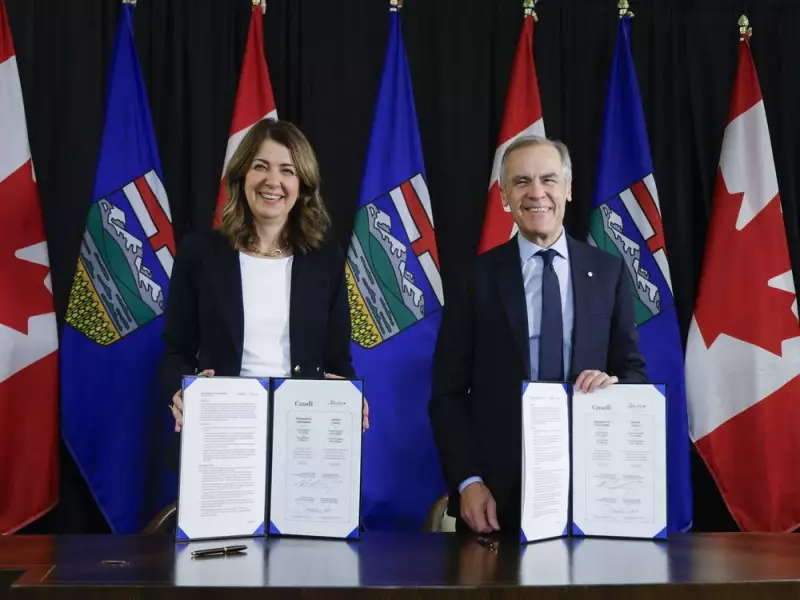
An agreement celebrated last month by Prime Minister Mark Carney and Alberta Premier Danielle Smith as a step forward for energy infrastructure is being criticized as a document that creates more problems than it solves. The Memorandum of Understanding (MOU), signed on November 27, 2025, regarding a potential bitumen pipeline to the West Coast, is being labeled a masterclass in optics over substance, containing provisions that may actively deter the private investment needed to make such a project a reality.
Key Provisions Seen as Investment Killers
Legal and energy experts point to several clauses within the MOU that introduce significant uncertainty for any potential investor. The most critical issue revolves around the federal West Coast tanker ban. The MOU states that if a pipeline is approved, an export provision will be enabled only "if necessary" and through an "appropriate adjustment" to the existing ban.
This vague, discretionary language offers no guarantee to a company spending tens of millions on regulatory approval that it will be legally permitted to ship product or that sufficient tanker capacity will be authorized. The backward sequencing—seeking pipeline approval before resolving the tanker issue—is viewed as a fundamental flaw that makes financial commitment untenable.

Indigenous Veto and B.C. Opposition Add Layers of Risk
Further complicating the investment landscape is the MOU's approach to Indigenous partnership. Premier Smith indicated Indigenous co-ownership could reach 50 per cent, which effectively grants a partner a veto. From a private investor's perspective, this means committing billions of dollars for only a half-interest, half the dividends, and half the potential equity growth—a difficult proposition to justify.
Additionally, the MOU bows to political pressure from British Columbia, despite interprovincial pipelines falling under federal jurisdiction. It mandates that Canada and Alberta immediately "engage" B.C. in trilateral discussions. This introduces a new potential choke point: what happens if these talks fail because B.C. refuses to agree or demands unacceptable terms? The MOU provides no answer.
Heavy Preconditions and Costly Carbon Commitments
To secure Ottawa's signature, Alberta agreed to significant concessions on carbon pricing. The province must adopt an industrial carbon pricing system, with details to be finalized later, that ramps up to $130 per tonne in 2026. This future agreement will cover not just oil but also Alberta's gas and electricity sectors, likely triggering energy price increases for consumers and businesses.
Furthermore, the MOU sets a precondition requiring the Pathways Alliance consortium to enter a separate trilateral agreement with Alberta and Ottawa by April 1, 2026. This agreement would commit the oilsands group to the world's largest carbon capture, utilization and storage (CCUS) project, with an estimated cost between $16 and $24 billion. While CCUS technology exists, compelling such a massive, risky, and costly upscaling as a prerequisite for pipeline approval adds another layer of financial uncertainty.
In essence, analysts argue the November MOU replaces old, known barriers to pipeline development with a new set of complex, discretionary, and costly chokepoints. For private sector investors seeking certainty, the agreement may have made the path to a new West Coast pipeline less clear, not more.