

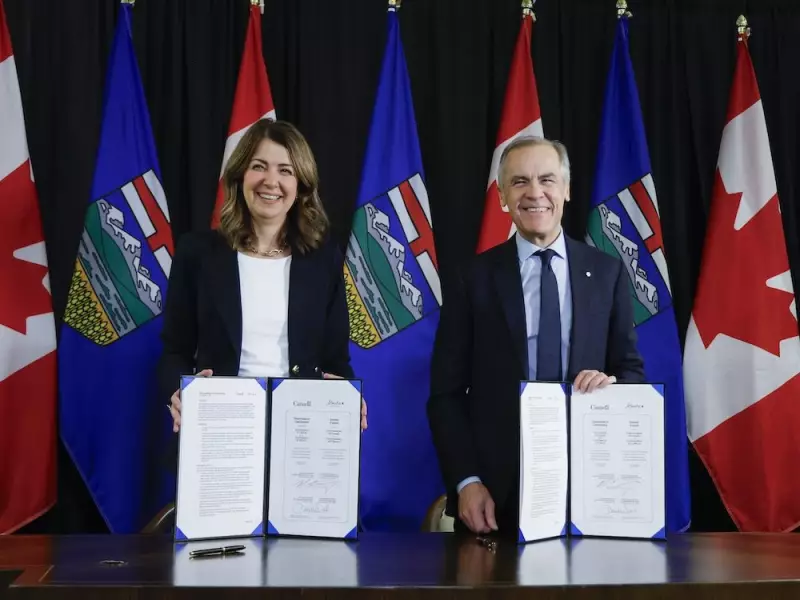
The recent signing of a Memorandum of Understanding (MOU) between the federal government and Alberta, aimed at building a new pipeline to tidewater, has been met with widespread political praise but deep skepticism from policy analysts. While headlines celebrated a breakthrough, a closer examination of the document reveals fundamental logical flaws and a critical omission that threatens the entire endeavour.
A Flurry of Political Optimism
On November 27, 2025, Prime Minister Mark Carney and Alberta Premier Danielle Smith signed the six-page MOU in Calgary. The agreement outlines a framework to advance a pipeline from Alberta through British Columbia to access global markets beyond the United States. The political reaction was overwhelmingly positive.
Former Alberta Premier Jason Kenney hailed it as an "historic agreement." Alberta NDP Leader Naheed Nenshi called it a positive step. The resignation of former environment minister Steven Guilbeault from Carney's cabinet was seen by some as a sign the deal had real teeth. Media outlets framed it as a hurdle-clearing moment, with Prime Minister Carney promising infrastructure development "at a speed and scale not seen in generations."

The Devil in the Details: An Incoherent Document
However, a meticulous review of the MOU's text tells a different story. The document is described as utterly incoherent, containing circular logic that undermines its own purpose. A prime example of this confusion is found in the agreement's treatment of prerequisites.
The MOU states: "Canada and Alberta agree that the approval, commencement and continued construction of the bitumen pipeline is a prerequisite to the Pathways project…" This refers to the associated carbon capture and storage initiative.
Immediately following, it asserts: "Canada and Alberta agree that the Pathways Project is also a prerequisite to the approval, commencement and continued construction of the bitumen pipeline, given that the two projects referred to in this MOU are mutually dependent."
This creates a classic logical paradox where two projects are each declared a prerequisite for the other, a situation that offers no clear path forward. The agreement then proposes to solve this conundrum by appointing an "Implementation Committee" to deliver outcomes. This committee is tasked with, among other things, determining how Alberta can submit its pipeline application to the newly created federal "Major Projects Office" by July 1, 2026.
The Missing Piece: Investor Confidence
Beyond the document's internal contradictions, the analysis identifies a more profound failure. Neither the federal nor the Alberta government has addressed the most critical issue: restoring the confidence of private investors. Years of regulatory uncertainty, shifting policies, and political conflict have eroded the trust required for multi-billion-dollar, long-term energy infrastructure projects.
The MOU, filled with bureaucratic language and circular reasoning, does nothing to provide the clear, stable, and predictable regulatory environment that capital markets demand. While governments can sign agreements and form committees, private investment is the essential fuel for any major pipeline project. By failing to directly tackle this core challenge, the much-touted MOU risks becoming another symbolic gesture rather than a concrete catalyst for construction.
The conclusion drawn is stark: the agreement is less a blueprint for action and more a manifestation of a process where only governments could produce a document that effectively obscures rather than clarifies the path to building critical national infrastructure.






