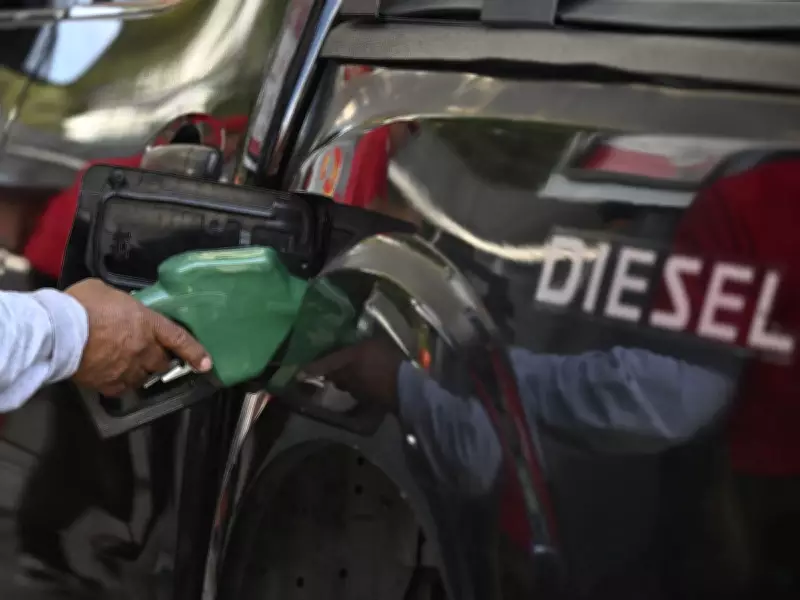
Diesel Price Surge Poses Greater Economic Threat Than Gasoline Pain
While Canadian consumers naturally focus on the financial hit from filling their gasoline tanks, experts warn that the rising cost of diesel—often called the "life of the economy"—could deliver a far more damaging blow to household budgets and the broader economic landscape.
The Supply Shock Driving Diesel Prices Higher
The United States-Israel-led conflict with Iran has significantly disrupted global fuel supplies, removing approximately 10 million barrels of oil daily from international markets. According to an Oxford Economics Ltd. report, this has created a substantial 10 percent supply shortfall, putting intense pressure on diesel availability and pricing.
Since hostilities began in the Middle East, the average price of diesel in Canada has surged by 45 percent. This dramatic increase carries serious implications because diesel serves as the critical fuel for multiple essential industries including freight transportation, agricultural operations, and construction projects.

Why Diesel Matters More Than Gasoline
Randy Ollenberger, managing director and oil and gas analyst at BMO Capital Markets, explains the fundamental importance of diesel: "Diesel is really kind of the life of the economy because it is what you consume to ship products by rail, by truck and, again, if you have a large agricultural sector, like we do in Canada, that's the product you need in order to run the sector. Diesel is often considered a good indicator of economic health."
The numbers illustrate the dramatic shift. According to Kalibrate Technologies Ltd., the average retail price for a litre of diesel in Canada reached $2.37 recently, compared with just $1.63 before the conflict began and $1.46 at the start of 2026.
Inflationary Pressures and Economic Vulnerability
Douglas Porter, chief economist at BMO Capital Markets, noted during an investor presentation that diesel prices have "rocketed" upward more sharply than gasoline prices, similar to patterns observed when Russia invaded Ukraine. This rapid increase raises significant concerns about food prices due to what Porter describes as the "tight linkage" between energy costs and grocery expenses.
Food inflation already presents a persistent challenge, with recent consumer price index data showing grocery store food inflation at 4.1 percent year-over-year compared to overall CPI of just 1.8 percent. Elevated diesel prices threaten to exacerbate this situation, putting additional pressure on household budgets.
Global Rationing and Supply Chain Implications
The problem extends beyond simple price increases. Bridget Payne, head of energy forecasting at Oxford Economics, emphasizes in her report that industries relying on diesel "cannot easily switch fuels or stop operating without broader economic disruption." She adds: "That means diesel demand falls relatively little through price alone, which is exactly why diesel shortages are so economically damaging."
Countries with energy supplies more exposed to Middle Eastern disruptions have already implemented rationing measures. Both the Philippines and Pakistan have shortened their workweeks from five days to four, while Bangladesh has imposed fuel purchase caps. Myanmar has resorted to alternating driving days, and Thailand has capped diesel prices while banning fuel exports entirely.
North American Position and Market Connections
While physical diesel shortages have not yet emerged in North America, Canada's position as both an exporter and importer of the fuel creates vulnerability. Ollenberger notes that "the combination of those things does tie us to international markets," meaning global supply disruptions inevitably affect Canadian prices and availability.
The diesel price surge represents more than just another energy cost increase—it threatens to ripple through supply chains, elevate food prices, and potentially slow economic activity across multiple sectors that form the backbone of Canada's economy.