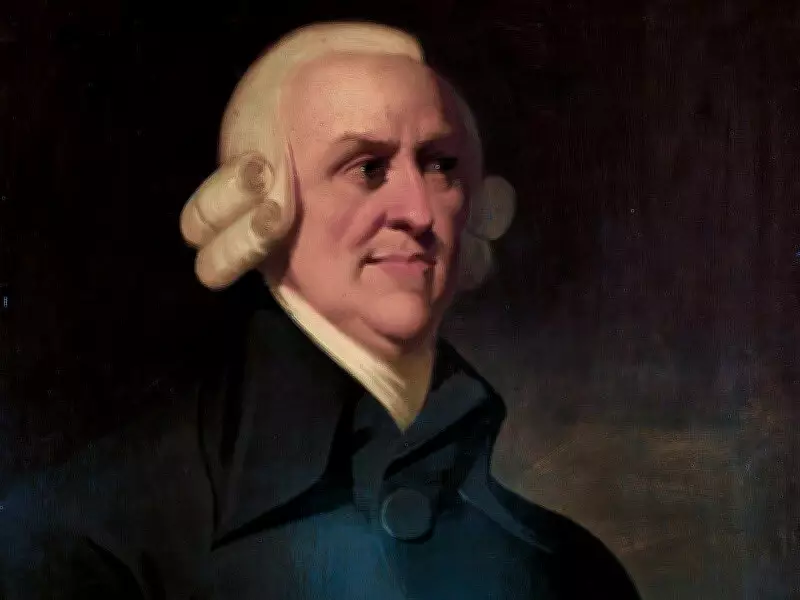
Donald Boudreaux: Wealth Has Causes, Poverty Does Not
Adam Smith demonstrated that when people gain greater access to goods and services, nations become wealthier
This Monday, March 9, marks exactly 250 years since the publication of Adam Smith's groundbreaking work, An Inquiry into the Nature and Causes of the Wealth of Nations. In the quarter millennium since its release in 1776, no more compelling case for free markets has ever been presented. These commercial arrangements naturally emerge when individuals possess the freedom to spend their incomes peacefully as they choose and to earn those incomes through whatever peaceful means they desire.
The Revolutionary Nature of Smith's Work
Smith's advocacy for free markets was remarkably modern and liberal for its time. Throughout most of human history, societies were dominated by rigid hierarchies where nobles, gentry, and guild members enjoyed protected status. While the masses supported these privileged few, they were systematically prevented from competing with them for prestige and resources. Any activities that threatened to disrupt this established arrangement faced severe restrictions, suppressing economic change and, consequently, economic growth.

This system worked splendidly for the powerful elite but proved disastrous for ordinary people. However, beginning in 17th-century Holland and accelerating dramatically in 18th-century Britain, this arrangement began to unravel. Merchants discovered increasing freedom to innovate, including applying Enlightenment scientific principles to manufacturing and transportation processes. Guilds gradually lost their monopoly power, and for the first time in recorded history, the living standards of common people began rising consistently without subsequent retreats.
The Nature of True Wealth
Significantly, the swelling wealth of the masses did not come at the expense of the accumulated wealth of the rich. Although the privileged classes began losing their exclusive status and station, their absolute standard of living did not decline. Nearly everyone in Britain grew richer during this period, and the overall wealth of the nation increased substantially.
Observing this novel phenomenon, Adam Smith, then a professor of moral philosophy, dedicated himself to exploring and explaining it. The result was a masterpiece of economic thought, whose full title provides a handy guide to Smith's explanation: An Inquiry into the Nature and Causes of the Wealth of Nations.
The opening words of this title reveal Smith's intellectual humility. His book represents an inquiry rather than a final pronouncement—an initial contribution to ongoing intellectual exploration. Smith wrote not as a prophet dispensing dogma but as a companion surveying new economic terrain alongside his readers. His implicit invitation remains: "Come along with me as I inquire into these fascinating topics."
Wealth Beyond Money
Smith's inquiry first addressed the fundamental nature of wealth itself. In the mid-18th century, the widespread belief, tenaciously embraced by mercantilists, held that wealth consisted primarily of money. According to this view, a nation that accumulated precious metals (the primary monies of the era) grew wealthier, while a nation that lost precious metals became poorer.
Smith fundamentally disagreed with this mercantilist perspective. He recognized that people cannot eat, clothe themselves, or treat illnesses with money alone. True wealth, he explained, consists of what money can purchase—food, clothing, shelter, healthcare, education, and all other real goods and services that genuinely raise people's living standards. A nation becomes wealthier not when its people accumulate more money but when they gain greater access to actual goods and services.
Smith's revolutionary insight transformed economic thinking by shifting focus from mere monetary accumulation to the actual improvement of human well-being through increased production and distribution of tangible benefits. His work established the intellectual foundation for understanding how free markets, innovation, and expanded access to goods create prosperity that benefits all members of society, not just privileged elites.