

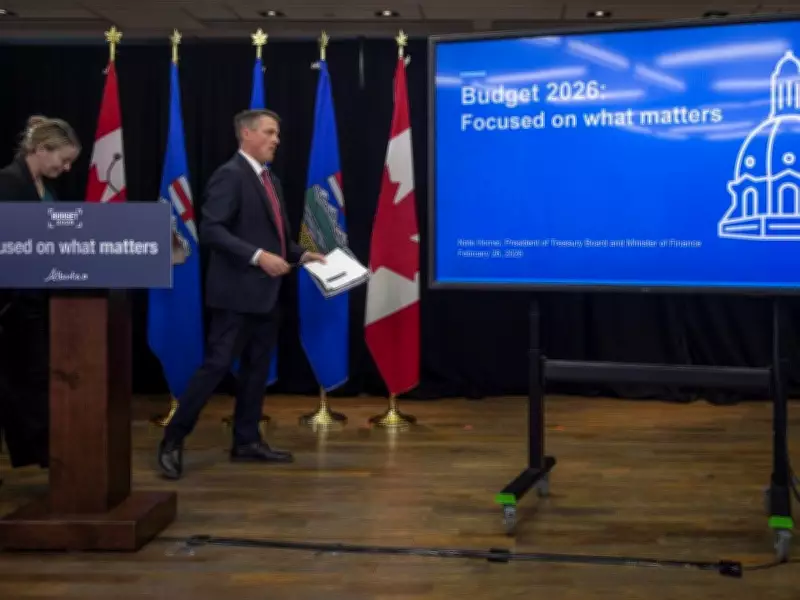
In the lead-up to the release of Alberta's 2026 budget, NDP Leader Naheed Nenshi asserted that his party had managed the province's finances more effectively during its tenure. Nenshi contended that under former Premier Rachel Notley, the NDP never proposed deficits of the magnitude now forecast by the United Conservative Party government for the upcoming four-year period.
Examining the UCP's Fiscal Projections
The budget presented by Finance Minister Nate Horner on Thursday, February 26, 2026, outlines a series of substantial deficits for Alberta's immediate fiscal future. The current fiscal year, ending March 31, is projected to conclude with a $4.1 billion deficit, a stark reversal from the previous year's $8.3 billion surplus. This represents a dramatic $12.4 billion swing in the province's financial position within a single year.
The outlook becomes progressively more challenging in subsequent years. The 2026-27 budget anticipates a $9.4 billion deficit, followed by $7.6 billion in 2027-28, and $6.9 billion in 2028-29. These projections are contingent upon a rebound in oil prices, highlighting the budget's reliance on revenue fluctuations rather than spending controls.

Spending Patterns Under Scrutiny
A critical examination reveals that the UCP budget lacks meaningful spending restraints. Expenditures are set to increase by six percent to $84 billion in 2026-27, followed by a three percent rise the subsequent year, before experiencing a marginal decrease of one-tenth of one percent in 2028-29. While these increases are not historically extreme, they notably fail to keep pace with projected population growth and inflation rates. When adjusted for these factors, the announced expenditures actually represent a net per capita decrease in government spending by 2029.
Comparing Fiscal Records: UCP Versus NDP
Contrary to Nenshi's claims of NDP fiscal prudence, a detailed comparison of deficit records reveals a different narrative. The UCP's projected deficits for the next four years—$4.1 billion, $9.4 billion, $7.6 billion, and $6.9 billion—while substantial, pale in comparison to the NDP's inflation-adjusted deficits during their administration.
When accounting for inflation, the NDP's deficits were significantly larger: $14.1 billion, $10.2 billion, $8.4 billion, and $15.1 billion over their four-year term. This analysis demonstrates that, with the exception of the $9.4 billion deficit projected for the coming year, the worst of the UCP's anticipated deficits remains better than the best deficit year achieved by the NDP government.
Contextualizing the Spending Approaches
During their time in office, the NDP implemented spending increases of 7.6 percent, 3.6 percent, zero percent, and 3.5 percent across their four budgets. While these figures indicate some restraint, the resulting deficits were considerably larger than those now projected by the UCP. The current government's approach, though criticized for its lack of spending controls, appears to result in more manageable deficit figures when compared directly with the previous administration's fiscal performance.
The debate over Alberta's fiscal management continues to center on the balance between revenue dependence and expenditure control, with historical comparisons providing crucial context for evaluating current budgetary decisions.






