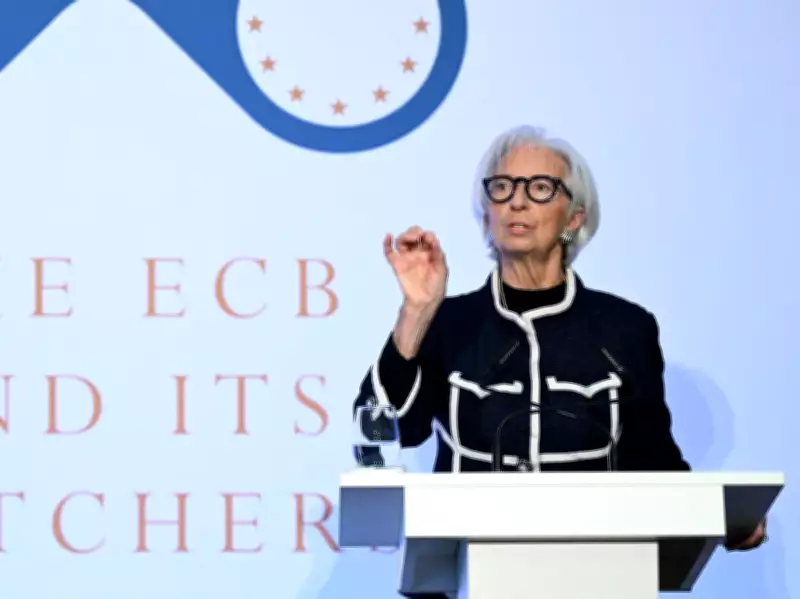
European Central Bank President Christine Lagarde has announced that the euro-zone economy has moved away from the ECB's baseline projections, primarily influenced by over six weeks of conflict in the Middle East. However, she emphasized that this deviation is not currently sufficient to justify a shift toward raising interest rates.
Economic Impact of Middle East Conflict
During an interview with Bloomberg Television on Tuesday in Washington, where she is attending the International Monetary Fund's spring meetings, Lagarde stated, "We are in between the baseline and the adverse scenarios." The ongoing fighting has driven energy costs significantly higher and negatively impacted economic sentiment across Europe.
Inflation Concerns and ECB's Stance
Headline inflation in the euro zone has already surged well beyond the ECB's two percent target. The critical issue now is determining how persistent this inflationary spike will be. Lagarde clarified that the ECB does not have a bias toward tightening monetary policy at this time. "We have a compass which indicates price stability predicated on financial stability," she explained.

The ECB is carefully evaluating what actions may be necessary as the conflict continues. The closure of the Strait of Hormuz has exacerbated the situation, making the baseline economic outcome less likely according to several officials from the Frankfurt-based central bank.
Market Expectations and IMF Projections
Financial markets are anticipating that interest rate hikes are inevitable, pricing in more than two quarter-point increases this year. However, with peace talks between the U.S. and Iran remaining uncertain, markets are leaning against an immediate rate hike at the ECB's next meeting scheduled for April 29-30.
New IMF projections released earlier on Tuesday suggest faster global inflation alongside more modest growth. For the 21-nation euro zone, consumer prices are expected to rise by 2.6 percent this year, aligning with the ECB's own forecast.
Potential Scenarios and Future Outlook
If the current situation deteriorates further, the adverse scenario envisions inflation peaking at 4.2 percent. A more severe scenario could include a short recession and price gains exceeding six percent. For now, ECB officials are monitoring how strongly higher energy costs are permeating other sectors of the economy, with particular attention to wage demands, which escalated dramatically after inflation surpassed 10 percent following Russia's invasion of Ukraine in 2022.
Lagarde reiterated the ECB's cautious approach: "We've said very clearly that we would need data to act, but that we would not hesitate to act. It really captures well the position that we have. We need the data in order to analyze whether it's a see-through, it's going to be short-lived, we will get back to the past, if you will. Although I don't think that's actually possible."
The ECB remains committed to maintaining price stability while navigating the economic uncertainties posed by geopolitical tensions, ensuring that any monetary policy adjustments are data-driven and timely.