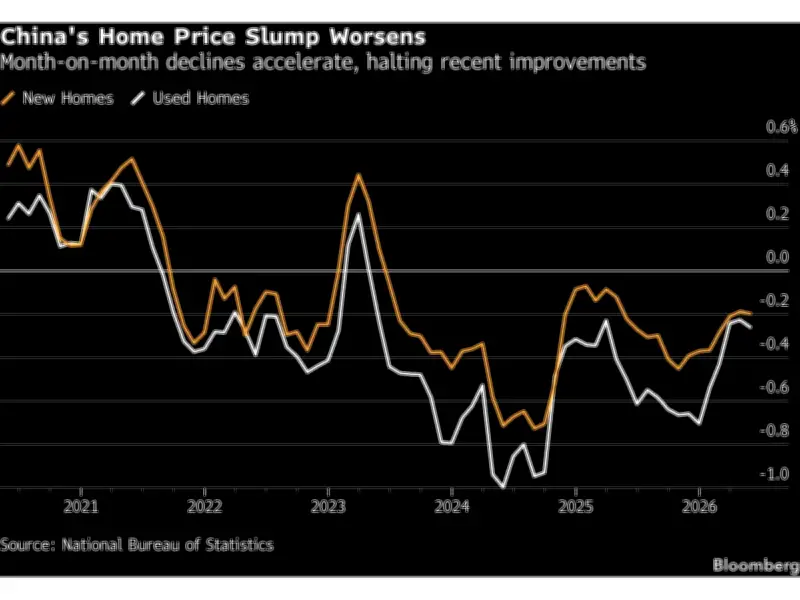
China’s consumer spending and investment slumped to levels unseen since the pandemic, exposing risks still facing the economy even as it benefits from a deescalation in tensions around Iran while exports boom.
Retail Sales and Investment Decline
Retail sales declined 0.6 percent last month from a year ago, posting a worse-than-forecast drop that was their first fall since the reopening from COVID lockdowns in late 2022. Home prices fell at a quicker pace in May, and fixed-asset investment shrank more than expected by retreating 4.1 percent in the first five months from a year ago, according to data released by the National Bureau of Statistics on Tuesday.
Industrial Production Shows Strength
In contrast to weakness on the demand side, industrial production climbed 4.5 percent, up from 4.1 percent in April and slightly better than forecast. The surveyed urban jobless rate eased to 5.1 percent.

“While there are pockets of strength in tech and export-related industries, the broader economy is still struggling,” said Lynn Song, chief economist for Greater China at ING Bank NV. “This could eventually add pressure on policymakers to ease policy.”
Export Boom Creates Imbalance
An export boom driven by artificial intelligence has become a new source of economic imbalance in China, lifting production as domestic consumer spending sags under the weight of a housing crisis and a fragile jobs market. But without stronger demand at home, the economy is at risk of a deeper slowdown even as the United States-Iran deal to reopen the Strait of Hormuz holds out the promise of stabilizing global shipping and energy prices.
Bloomberg Economics Analysis
“May’s activity data underscore a widening two-speed economy. The supply side remains robust, driven by faster-than-expected expansion in exports and AI tech sectors. The demand side has faltered, with consumption and private non-tech investment plummeting,” wrote Chang Shu and Eric Zhu of Bloomberg Economics.
Data Accuracy Questions
The worse-than-expected slump in retail sales and investment also reignited questions around their accuracy in gauging broader economic health. The services production index, which inched up to 4.4 percent on year in May, has a stronger correlation with the pattern of growth in gross domestic product than retail sales, which comprised mostly goods, according to Yu Song, chief China economist at UBS Securities. Inconsistency in the fixed-asset investment data that became apparent last year also mean it might exaggerate the weakness, he said.
“Second-quarter GDP data looks to be weak, but not quite as weak as one would expect from April data,” Song told Bloomberg Television. Some analysts estimated growth at near four percent in April, tracking below the government’s official full-year target of 4.5 percent to five percent.
In a sign the figures disappointed investors, the yuan weakened in offshore trading after the data release, a day after reaching its strongest level since early 2023. The Hang Seng China Enterprises Index extended losses, falling about 1.3 percent as of 1 p.m. in Hong Kong.