

Boast's 2026 R&D Tax Credit Benchmark Report Unveils $900M+ in Secured Credits Across North America
Vancouver, March 26, 2026 – Boast, the leading R&D tax credit platform in North America, has released its comprehensive 2026 R&D Tax Credit Data and Statistics: Benchmark Report. This detailed analysis provides unprecedented insights into how innovative companies are leveraging government incentives to fund research and development activities. The report discloses that companies secured more than $900 million in R&D tax credits in 2024 alone, with average claim values skyrocketing by 245% since 2018, now reaching $768,233.
In-Depth Analysis Based on Verified Transaction Data
The benchmark report meticulously examines 6,907 real R&D tax credit claims, representing over $3.6 billion in tracked R&D expenditures from 2,298 companies across the United States and Canada. Unlike conventional industry surveys, this report is grounded entirely in verified transaction data from the 2024 tax season, ensuring accuracy and reliability. The findings indicate a significant shift in the market, where claim volumes have stabilized, but values continue to climb, reflecting a maturing landscape where companies are adopting multi-year optimization strategies.
Key Findings and Strategic Implications
Major Highlights from the Report:

- Over $900 million in R&D tax credits were secured in 2024 across the U.S. and Canada.
- Average claim value surged 245% since 2018, hitting $768,233 in 2024.
- Software and internet companies dominate, accounting for 80.6% of all claims and boasting the lowest audit rate at 5.28%.
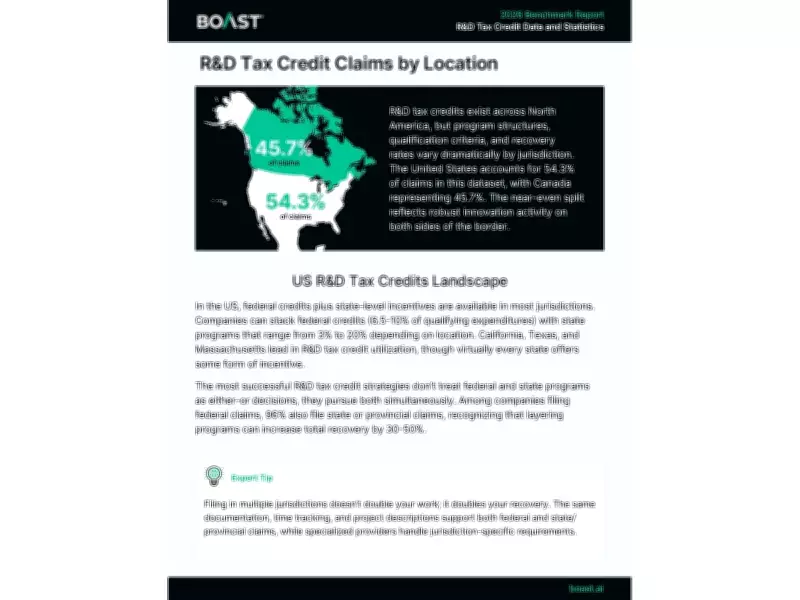
- The United States leads in total claims volume with 54.3%, while Canada shows strong participation at 45.7%, highlighting robust cross-border innovation.
- In the U.S., California, Texas, and Massachusetts are top states for R&D credit utilization, whereas in Canada, Quebec and Ontario lead, driven by enhanced provincial programs.
- Small and mid-sized businesses (SMBs) are the primary drivers, contributing 90% of claims.
- Sophisticated claimants pursuing multi-jurisdiction strategies achieve 30% to 50% higher recoveries.
- Overall audit rates remain low at 6.59%, with 93% of claims passing without review.
Expert Insights on Innovation Funding Trends
Imad Jebara, CEO at Boast, commented on the findings, stating, "The substantial increase in average claim values and the millions of dollars secured in a single year clearly demonstrate that companies are becoming far more strategic in funding innovation. However, this is just the beginning. There is still significant untapped potential in fast-growing innovation markets like the U.S. and Canada, where many companies have yet to fully capitalize on government incentives."
Jebara emphasized that while AI can accelerate data collection and analysis, it cannot replace human judgment in identifying technical uncertainty, documenting experimentation, and capturing critical details that impact recovery. "The strongest outcomes result from combining advanced technology with experienced specialists who understand how to transform R&D activity into defensible, maximized claims," he added.
Market Maturation and Future Outlook
The report notes that companies previously recovering $50,000 to $100,000 annually are now routinely securing $200,000 to $500,000 or more as they expand R&D operations and enhance documentation practices. This trend underscores a shift towards more sophisticated, optimized approaches to tax credit claims. Additionally, optimized companies can reduce processing timelines by up to three months, accelerating access to capital for further innovation.
With manufacturing and gaming sectors facing the highest audit scrutiny, and software remaining the lowest-risk sector, the data provides valuable guidance for businesses navigating the R&D tax credit landscape. As the market continues to evolve, Boast's report serves as a crucial resource for companies aiming to maximize their innovation funding through strategic use of government incentives.






