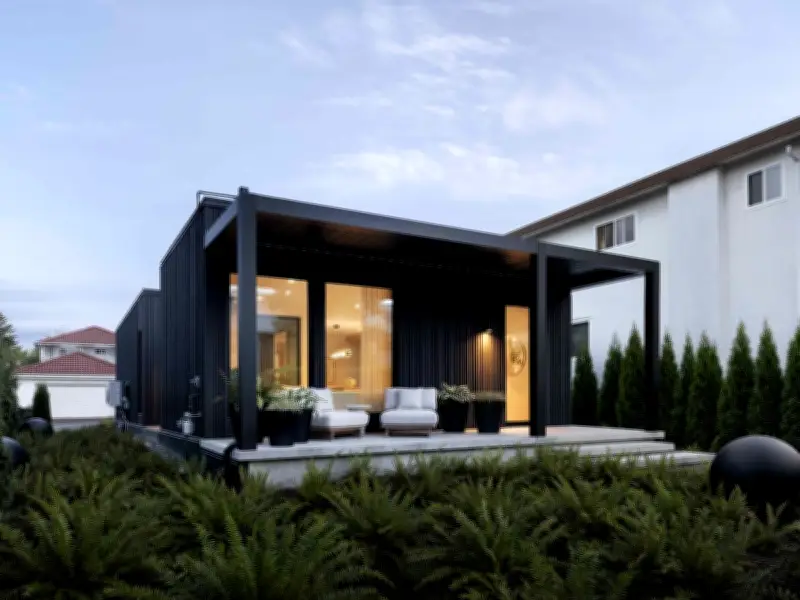
Commonplace Vancouver is rethinking luxury home construction by combining precision manufacturing with premium finishes and turnkey delivery, challenging long-held stereotypes about prefabricated housing.
Rethinking Prefab: From Compromise to Custom Luxury
For decades, prefabricated housing has promised faster, simpler, and less wasteful homebuilding. However, the term "prefab" still evokes compromise—repetitive designs, lightweight construction, and houses chosen primarily for cost savings and speed over architecture. Commonplace aims to eliminate these assumptions by producing precision-manufactured homes that compete with high-end custom architecture.
Founders Edmund Lee, Rich Frontain, and architect Walker McKinley—whose backgrounds span manufacturing, business, commercial interiors, architecture, and design—launched Commonplace to disrupt conventional homebuilding. Their goal is not a better budget prefab but a genuinely luxurious, fully finished, turnkey product. Much of the work is completed before components reach the property, reducing construction time and the number of trades required on-site.

Seven Years in the Making: The Courtyard Concept
Commonplace originated from a conversation about building homes differently, says Lee. "The initial thought to disrupt how homes were built using non-conventional materials started over a casual lunch seven years ago." What followed was a lengthy development process focused on both manufacturing and producing a genuinely luxurious home.
Rather than designing a standard box repeated with minor variations, Commonplace centered its concept on a courtyard. The courtyard connects indoor and outdoor spaces, brings natural light deeper into the home, and makes rooms feel more expansive. "The homes are designed around the ethos of Essential Living, where the rooms are generous for comfortable living without excessive spaces," explains Lee.
The courtyard serves as the connection between exterior and interior, making the home feel larger than its square footage. Finishes combine to provide a warm, inviting ambience. The result offers the comfort, proportions, and material quality of a custom-designed home without unnecessary rooms or wasted circulation space.
Obvious Luxury: Design and Materials
Prefabrication does not have to mean sacrificing architecture, materials, or finish, says Lee. Commonplace designs its prefabs to be compared with bespoke luxury houses rather than low-cost modular buildings. Features include carefully proportioned layouts, large courtyards, Italian-made kitchens, integrated storage, and interiors influenced by modernist, Japanese, and Scandinavian design.
McKinley emphasizes: "From the design itself to the quality of windows and finishes to how they’re joining the walls, we didn’t want it to feel like a prefab." The streamlined kitchen opens directly onto the central courtyard, and the dark modern exterior pairs with a sheltered terrace, as seen in the Vancouver showhome photographed by Ema Peter.
Impact and Future of Luxury Prefab
By challenging stereotypes, Commonplace is positioning itself at the intersection of manufacturing efficiency and high-end design. The company’s approach reduces on-site labor and construction time while delivering premium finishes and architectural integrity. This model could reshape perceptions of prefab housing, making it a viable option for discerning homeowners seeking both quality and efficiency.