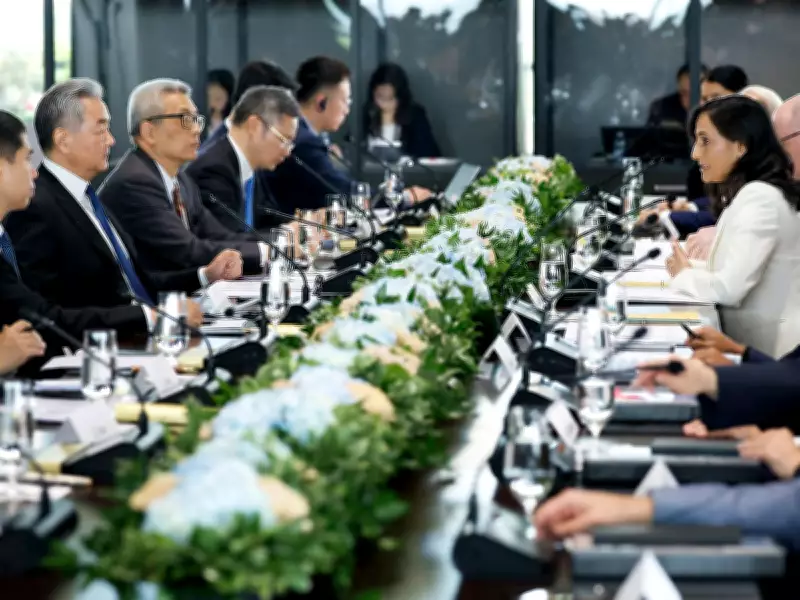
Foreign Minister Anita Anand announced that Canada intends to boost exports to China by 50 percent by 2030, as Chinese Foreign Minister Wang Yi made his first visit to Ottawa in a decade. The visit signals a shift in global trade dynamics influenced by U.S. tariffs under President Donald Trump.
Strategic trade diversification
Wang Yi's trip included a meeting with Prime Minister Mark Carney on Friday. Trump's trade policies have pushed Carney to accelerate efforts to diversify Canada's trade, with expanded oil and gas shipments to China being a key priority. Speaking before her meeting with Wang, Anand noted that total bilateral trade between Canada and China reached $125 billion last year.
“We are committed to growing this relationship responsibly with a goal of increasing exports to China by 50 per cent by 2030, while safeguarding Canada’s economic and national security interests and values,” she said.

Previous diplomatic efforts
Wang's visit follows Carney's fence-mending trip to Beijing in January, where he struck a deal with President Xi Jinping to lower trade barriers. As part of that agreement, Canada will allow 49,000 Chinese electric vehicles annually at a tariff rate of 6.1 percent, removing a 100 percent surtax, in exchange for China easing agriculture tariffs. During his Beijing trip, Carney heralded Canada's new “strategic partnership” with China, telling Premier Li Qiang that it “sets us up well for the new world order.”
Wang said Friday that the bilateral relationship has achieved a “turnaround” and is now “improving and growing,” something he said is in the interest of both countries. Anand said China and Canada's leaders have set out a “clear and ambitious vision” for the countries' new relationship. “It includes elevated engagement and cooperation on trade and investment, energy, finance, public security and safety, and people-to-people ties,” she said.
Diplomatic discussions and future plans
A readout from Anand's office later said the ministers discussed a “wide range of topics in a frank and constructive manner, including consular issues, foreign interference, forced labor and human rights.” The countries will regularize annual foreign ministers' meetings and resume mechanisms to discuss sensitive bilateral issues and national security. Canada has accepted China's invitation to be a country of honour at the China International Import Expo in Shanghai in early November, and “the ministers discussed supporting two-way investment and trade in clean and conventional energy.”
Carney's government has promised to support the province of Alberta's proposal for a new oil pipeline to Canada's west coast, which would carry at least one million barrels a day for shipment to Asia. Currently, Canada only has one pipeline that serves Asia, and most of the country's oil still goes to the U.S.