

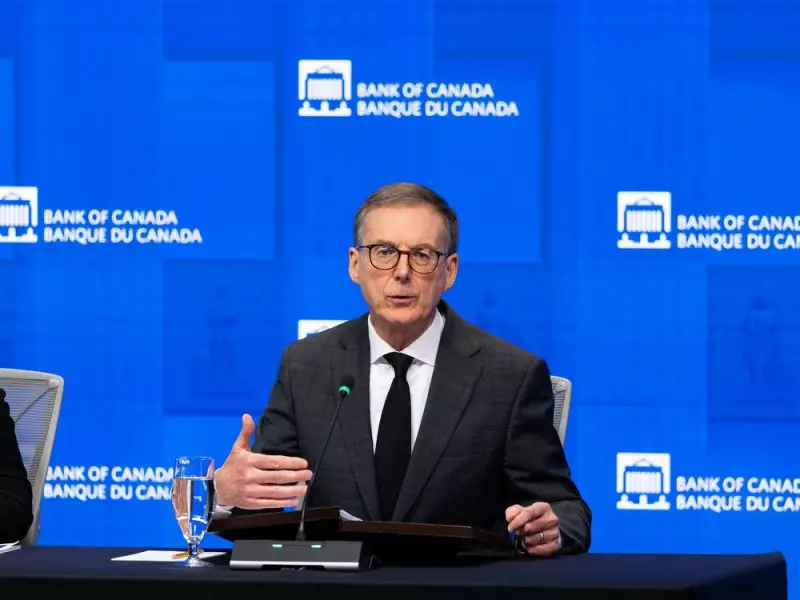
Bank of Canada Maintains Rate Amid Economic Uncertainty, Sparking Divergent Forecasts
The Bank of Canada has opted to hold its benchmark interest rate steady at 2.25 per cent for the second consecutive meeting, a decision driven by what it describes as elevated levels of economic and geopolitical uncertainty. This cautious stance has injected significant ambiguity into the outlook for monetary policy, with economists now presenting a wide spectrum of predictions for 2026, ranging from potential rate cuts to hikes or further holds.
Central Bank Cites Guarded Economic Conditions
In its latest announcement, the central bank reiterated its position from previous decisions in September and December, stating that the current rate is "at about the right level to keep inflation close to two per cent while helping the economy through this period of structural adjustment." However, officials explicitly noted that "uncertainty is heightened" and affirmed their readiness to respond should risks materialize. The governing council acknowledged the difficulty in predicting the timing or direction of the next interest rate move, reflecting a more guarded assessment of economic conditions.
Policymakers indicated that Canada's economy likely stalled in the fourth quarter, though they anticipate growth in the first quarter. Nevertheless, several soft spots persist, including:

- Uncertainty surrounding the Canada-United States-Mexico Agreement (CUSMA) renegotiation.
- Elevated unemployment levels.
- A reluctance among businesses to hire or make capital investments.
Economists Offer Conflicting Views on Future Rate Trajectory
The Bank's communicated uncertainty has directly influenced economist forecasts, leading to a notable split in projections for 2026. Analysts from major institutions have provided divergent interpretations of the central bank's stance and the economic landscape.
Desjardins Group: Risks Skewed to the Downside
Royce Mendes, managing director and head of macro strategy at Desjardins Group, observed that the Bank of Canada's description of economic conditions has become "much more guarded." He pointed out that while the January Monetary Policy Report indicated easing inflation expectations—with the three-month annualized rate falling below the two per cent target—the communiqué emphasized that guidance is conditional on the economy evolving as expected.
"This is all consistent with our view that the Bank of Canada sounded too certain late last year about the trajectory of the economy and rates, which has now been corrected," Mendes said. "We continue to believe that the risks to interest rates are skewed to the downside in the first half of this year." This perspective suggests a potential for rate cuts if economic weakness persists.
Oxford Economics: A Path Toward Hikes
In contrast, economists at Oxford Economics Ltd., Tony Stillo and Michael Davenport, characterize the current 2.25 per cent rate as sitting at the low end of the Bank's neutral range of 2.25 to 3.25 per cent, describing it as "mildly stimulative for the economy." They note the Bank's forecasts for economic expansion of 1.1 per cent in 2026 and 1.5 per cent in 2027, with inflation remaining at target.
"Like most aspects of the Canadian outlook, the path ahead for the Bank of Canada will hinge on U.S.-Canada trade policy and the upcoming renegotiation of CUSMA," they stated. For now, Stillo and Davenport project that policymakers will hike interest rates early next year, assuming economic forecasts become more firmly established, ultimately lifting rates back to a neutral level of 2.75 per cent by mid-2027.
Uncertainty Dominates the Monetary Policy Landscape
The stark divergence in economist predictions underscores the profound uncertainty currently clouding Canada's economic outlook. The Bank of Canada's decision to hold rates reflects a balancing act between supporting growth and containing inflation, all while navigating unpredictable factors such as international trade dynamics and domestic business sentiment.

As the central bank monitors these evolving risks, its future moves will likely depend on incoming data related to growth, employment, and inflation trends. The split among economists highlights the challenges in forecasting amid volatile conditions, setting the stage for a closely watched period in Canadian monetary policy as 2026 approaches.





