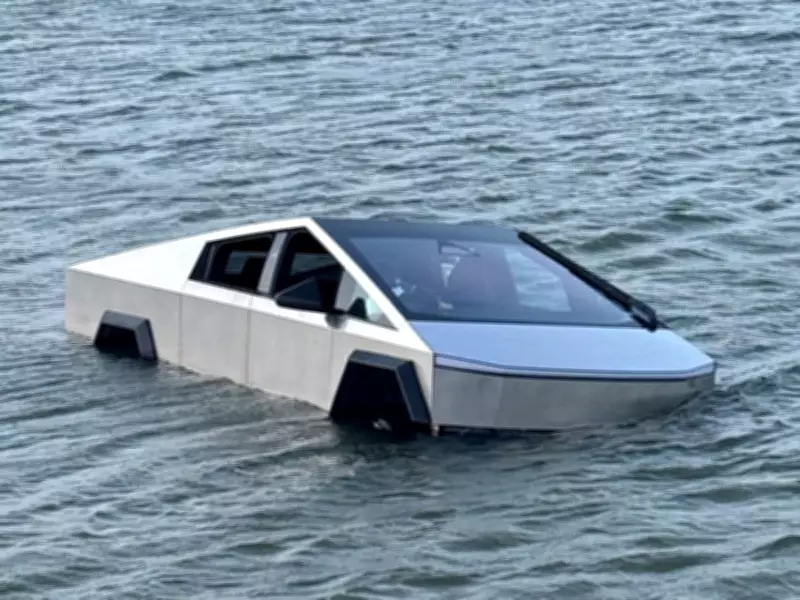
A Texas man learned the hard way this week that a Tesla Cybertruck is not a boat, but you can still be charged with boating-related offences for driving it in the water. The incident occurred at Grapevine Lake, a reservoir in the North Texas city of Grapevine, where the driver intentionally drove the electric vehicle into the water to test its 'Wade Mode' setting.
Incident Details
The Grapevine Police Department reported that officers were called to a boat ramp on Grapevine Lake after receiving reports of a vehicle in the water. Upon arrival, they found the angular Cybertruck stuck in the water, not far from the shoreline. The driver allegedly told police he drove into the water intentionally to test the vehicle's Wade Mode, which is designed to allow the truck to drive through bodies of water up to 81.5 centimetres deep.
However, the vehicle became disabled and took on water. The driver and passengers abandoned the vehicle, and the Grapevine Fire Department Water Rescue Team assisted in removing it from the lake. The driver later told a local NBC affiliate that he had successfully navigated water in the Cybertruck several times before, including the Atlantic Ocean.

Legal Consequences
Despite his previous success, the man was arrested and charged with operation of a vehicle in a closed section of the lake. Additionally, according to CNN, he was charged with not having a valid boat registration and other water safety equipment violations. Police emphasized that driving along the popular lake is prohibited to protect the safety of lake goers, beach users, and children who play along its shoreline.
Spokesperson Katharina Gamboa told CBS that the prohibition is both a safety and legal concern. 'It's a safety concern, but it's also a legal concern as well,' she said.
Wade Mode Details
The Wade Mode setting, as described in Tesla's online owner's manual, allows the Cybertruck 'to enter and drive through bodies of water, such as rivers or creeks' to a maximum depth of 81.5 centimetres (32 inches), about the height of a tire. However, Tesla warns: 'Do not drive in deep, fast-flowing bodies of water (such as strong currents or rapids). Doing so can result in damage, serious injury, or death.'
When enabled, the vehicle's ride height maxes out and the high-voltage battery automatically pressurizes to protect from water and debris. Tesla advises drivers to check underwater conditions before driving in and warns that the truck could sink in 'soft or muddy underwater surfaces.' Mud can also adhere to the radiator, reducing the effectiveness of the cooling system. Tesla cautions that 'it is your responsibility to gauge the depth of any body of water before entering,' noting that 'damage or water ingress … is not covered by the warranty.'
Elon Musk's Previous Claims
In September 2022, about 14 months before the first North American-made trucks rolled off a Texas assembly line, Tesla founder and CEO Elon Musk shared loftier aquatic aspirations for the Cybertruck on social media. He wrote: 'Cybertruck will be waterproof enough to serve briefly as a boat, so it can cross rivers, lakes & even seas that aren't too choppy. Needs be able to get from Starbase to South Padre Island, which requires crossing the channel.'
This incident serves as a reminder that while the Cybertruck may have some water-crossing capabilities, it is not a substitute for a boat, and drivers must adhere to local laws and safety regulations.