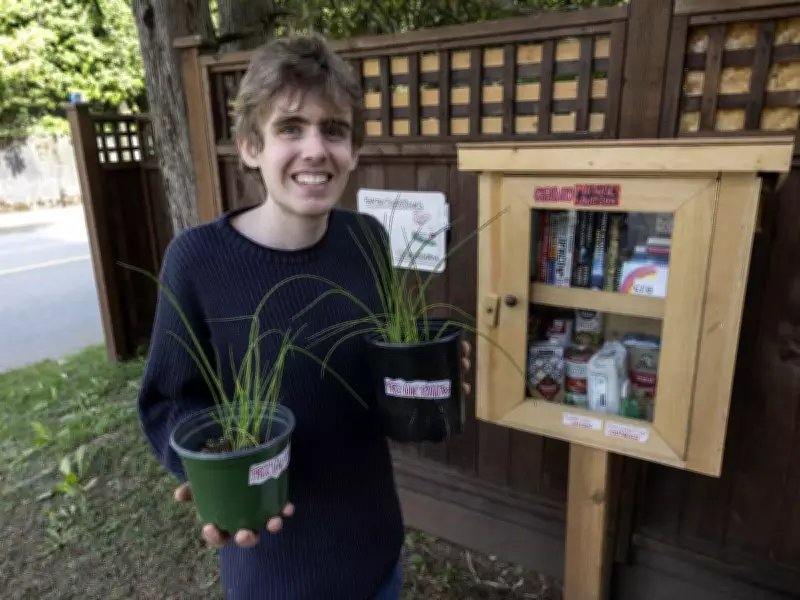
Across Metro Vancouver and the Fraser Valley, community food networks — including online food-sharing groups, curbside community pantries, and dumpster-diving meet-ups — are expanding as households turn to alternative ways to keep food on the table amid rising costs.
Chilliwack Free Store Becomes a Lifeline
In Chilliwack, a free store built on Facebook exchanges and community donations has become a vital lifeline for thousands of families. Soaring grocery prices are pushing more residents to seek help just to get by.
“Right now, demand is extremely high,” said Raylene Mumford, who founded the Free Store group in 2019. What began with Mumford posting her own leftovers in a Facebook group has grown into a wide-reaching community network where Chilliwack residents share surplus food or request what they need. It has now expanded into a physical storefront.

“Items are being claimed much faster than before, and postings go quickly,” she said. “It’s a contagion of community efforts to try and rescue each other from what’s happening right now.”
Rising Food Prices Across Canada
Recent data from Statistics Canada shows a sharp rise in food prices over the past five years. Ground beef, olive oil, coffee, and infant formula have all increased by at least half. In February 2021, the average price of beef ribs in Canada was $24.85 per kilogram. This February, it was $33.44. Ground beef rose to $17.20 from $10. Meatless burgers increased to $7.86 from $5.43.
Foods produced in B.C., such as chicken and dairy, have also become more expensive, as have imported items. Olive oil rose to $11.57 per litre from $7.40 in 2021. Coffee increased to $9.91 for 340 grams from $5.95, while orange juice went to $6.47 for two litres from $3.97. Infant formula saw a steep jump from $29.83 to $50.08 for 500 grams.
Community Response and Growing Need
In a report published last year, Living Wage B.C. found food costs are 28 per cent higher than in 2019, with one in five people now facing food insecurity, and food bank use up 81 per cent.
Mumford said demand within the Free Store network has continued to climb. Now connected to more than 13,700 people online, the group keeps working as locals keep giving one another a hand up by posting items, donating, and responding when someone asks for help.
“I have three children. I understand how quickly life can become overwhelming when the cost of food, rent, gas, and household basics keeps rising,” said Mumford.
Today, the Free Store supports about 4,700 families and 748 seniors who have signed up for help through the Facebook group, operating entirely by volunteers. It distributes nearly $800,000 in supplies annually.
“Donations are still coming in, and we are deeply grateful, but the need is moving faster and people are coming forward at a more desperate level,” Mumford said. “Even half bags of food or small amounts of supplies are being picked up because people are trying to stretch everything they have.”