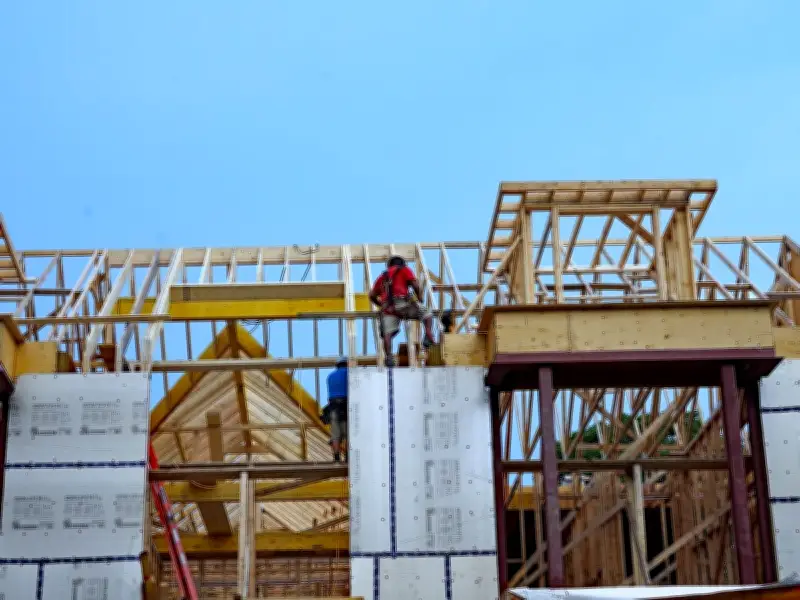
Trimming development fees could make dozens of housing projects across Canada more economically viable, according to the nation's housing agency, as the country seeks to significantly boost construction.
CMHC Report Highlights Impact of Development Charges
Development charges, levied by municipalities on housing developers to fund infrastructure such as roads, water, and transit, are particularly common in Ontario and British Columbia and vary widely. For instance, a two-bedroom apartment in Ottawa incurs development charges of $39,600, while in Markham the fee is $121,500, according to Canada Mortgage and Housing Corp. (CMHC) data.
Given that the average new build was 55 units in Ottawa in 2024 and 246 units in Markham, developers could face upfront fees of $2.2 million and $29.9 million, respectively. These costs pose a significant hurdle for project viability.

However, CMHC's analysis shows that cutting charges in half would boost the number of viable projects by about five percent in Toronto and Vancouver. An outright elimination would increase that figure to roughly ten percent.
“Reducing development charges can improve housing project viability, especially in communities where they are highest, but meaningful gains in supply require substantial reductions and they are only one part of the solution,” said Mathieu Laberge, CMHC’s chief economist. “Improving affordability will require a broader approach, including improved land-use regulation and increased scale and innovation to boost productivity in the construction industry.”
Affordability and Market Impacts
Beyond stalling projects, development charges also harm housing affordability. CMHC notes that these fees are passed down to homebuyers, often resulting in price increases larger than the fees themselves. Higher prices on new builds can also drive up costs for existing homes.
However, high development charges can be a double-edged sword, as they may lower prices for vacant land and help alleviate property taxes.
CMHC estimates that Canada needs to double its annual housing starts to between 430,000 and 480,000 new units by 2035 to meet demand. As of April, Canada was on pace for 256,777 housing starts in 2026.
In related news, professional stock pickers are struggling to gain an edge as Big Tech strengthens its grip on the stock market. Only about 20 percent of stock pickers have outperformed the S&P 500 this year, the worst performance since 2021. Upcoming IPOs from SpaceX, Anthropic PBC, and OpenAI are expected to further concentrate market leadership.