B.C. Amateur Astronomer Employs Complex Mathematics to Monitor NASA's Artemis II Lunar Mission
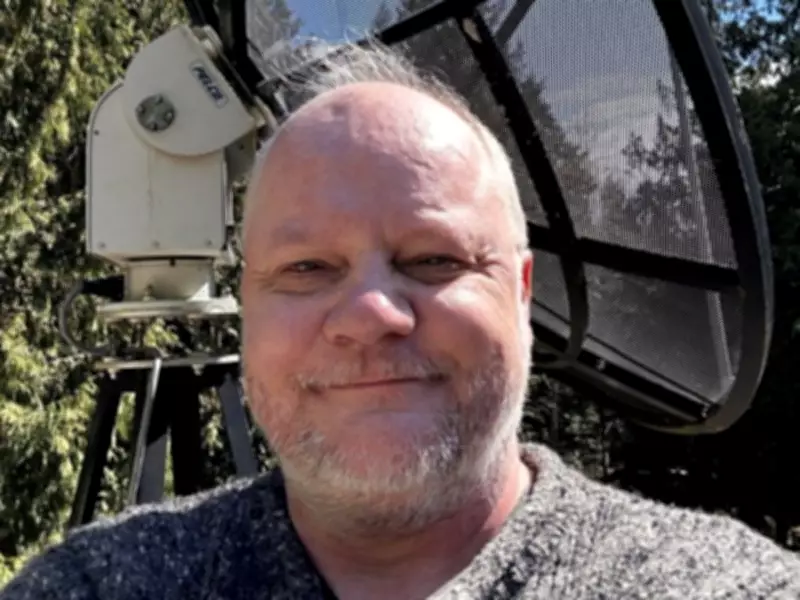
Scott Tilley, an amateur astronomer residing on British Columbia's picturesque Sunshine Coast, has long been captivated by the faint signals emitted by satellites and spacecraft orbiting high above Earth. From his home, he has dedicated years to tracking secret space missions, once even rediscovering a lost satellite, all through meticulous analysis of radio wave data.
Selected for NASA's Global Tracking Initiative
This week, Tilley's expertise has taken center stage as he participates in monitoring NASA's Artemis II rocket. He is one of only 34 individuals and organizations worldwide chosen by the American space agency to observe this historic crewed mission, which marks humanity's first return to lunar orbit in over five decades. The mission launched from Florida's Kennedy Space Center on Wednesday, carrying a crew of four astronauts, including Canadian spacefarer Jeremy Hansen.
"I'm excited to be part of it," Tilley remarked during an interview conducted on Thursday afternoon, shortly after the Artemis II spacecraft descended beyond 24 degrees below the horizon, rendering it temporarily untraceable from the British Columbia coastline. Despite his enthusiasm, he characterized the mission as somewhat "a little bland" compared to his usual pursuits, noting that "there's so much information in the media. It's so much more followed than other missions."

The Science Behind the Tracking
Tilley, who maintains a blog titled Riddles In The Sky, typically specializes in locating and observing classified satellites whose launches are not publicly disclosed. His setup includes an S-band radio and a two-meter dish antenna mounted on a rooftop platform at his residence. Using this equipment, he scans the skies for radio signals, which a software program records as frequency data. He then applies what he describes as "a whole lot of math" to extract precise positional information about satellites.
In stark contrast to his usual clandestine targets, the Artemis II mission is under intense scrutiny from NASA's Deep Space Network. This international array of massive radio antennas, strategically located in California, Spain, and Australia, serves as the agency's primary system for tracking interplanetary spacecraft. However, these facilities may not always represent the most efficient tracking solution available.
NASA's Experimental Tracking Program
Last August, NASA issued a formal request for proposals seeking volunteers capable of tracking spacecraft using radio wave technology. Tilley, who previously monitored the uncrewed Artemis I mission, was among the successful Canadian applicants, alongside the Canadian Space Agency and researchers from the University of New Brunswick. Throughout the ten-day Artemis II mission, these groups will continuously collect and transmit their tracking data to NASA for analysis.
"It's like a test of non-NASA systems, to see how well they can keep track," Tilley explained, highlighting the experimental nature of this collaboration. According to NASA's official statements, the collected data will help the agency "identify ways to augment future moon and Mars mission support." Tilley offers a more practical interpretation, suggesting this initiative explores whether smaller, more economical tracking stations utilizing technology similar to his could potentially supplement or even replace larger, more expensive primary systems on future lunar expeditions.
A Lifelong Passion for Radio Waves
Tilley's fascination with radio transmission began in childhood. He vividly recalls watching a 60 Minutes television segment with his father that featured young enthusiasts tracking Soviet satellites during the Cold War era. This early exposure sparked a lasting interest that eventually led him to pursue engineering studies at university. Over time, satellite tracking evolved from casual curiosity into a serious hobby, driven by his desire to deepen his understanding of celestial mechanics and the sophisticated mathematics underlying orbital dynamics.

Professionally, Tilley works as an electrical technologist, designing, installing, and repairing power systems for marine vessels. This technical background complements his astronomical pursuits, enabling him to apply practical engineering principles to the complex challenge of space object tracking. His participation in the Artemis II monitoring program represents a remarkable convergence of personal passion and professional contribution to space exploration.