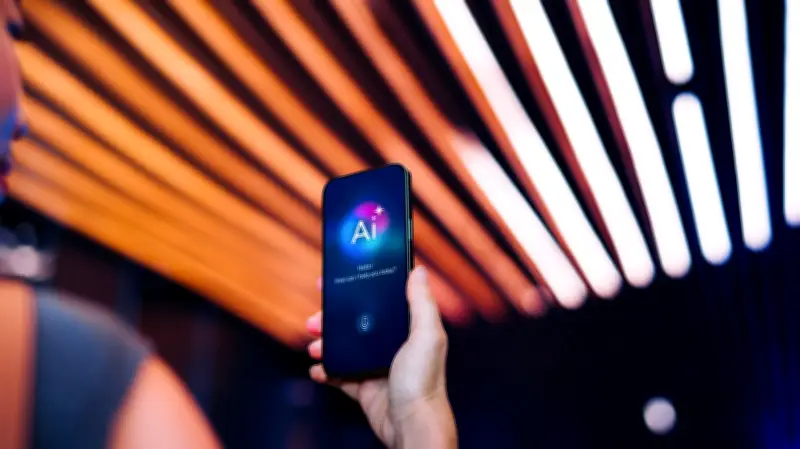
After entering a prompt into an AI chatbot like Claude or ChatGPT, many people naturally end their request with 'please' or 'thank you,' as they would during a call with a salesperson or after a directive to a colleague. It is human nature to want to be well-mannered when requesting a favor or asking for help, even from a very-not-human chatbot. But experts say you are likely wasting your time, and some of the world's energy and water, by being polite to AI.
And it is not just politeness that is unnecessary. Expressing certain emotions can impact the quality of the response you get from these chatbots. Here is what to know:
AI Does Not Care About Manners
An AI chatbot is not more accurate if you are polite, and it does not keep track of 'polite' or 'rude' users. 'AI doesn't care if we are polite,' said Vishal Misra, the vice dean of computing and AI at Columbia Engineering in New York.

Chatbot models go through three training phases, according to Misra, and none of them have anything to do with manners. The first phase involves dumping buckets of text on the models and training them to become good at predicting what comes next. The next phase involves training the model to become a chatbot and interpret a prompt. The final phase is teaching the chatbot how to sort through multiple answers and give the best one.
'There is nothing built into the model that will say if somebody says 'please,' give a better answer,' Misra explained. It also will not result in more positive interactions with the chatbot moving forward, said Sean Gorman, the CEO of Zephr.xyz. 'There's no hidden social credit score where they're tracking are you abusive or are you nice? and how you interact with the AI,' he said.
Getting Angry Makes the AI Worse
The accuracy of AI chatbots may suffer if you get really agitated. You do not have to be polite to AI, but voicing frustration or anger could impact the type of responses you receive. 'What my experience has been, and what a lot of these more recent benchmark studies have shown, is that actually getting angry at the AI causes it to spiral and degrade,' Gorman said. 'It makes more and more mistakes, because one, it's spending more time dealing with you being angry, and two, it gets more and more sycophantic, where it doesn't want to displease you. It doesn't want you to be upset.'
When your prompts and replies are 'f*** chatbots,' then it does all that it can, as fast as it can, to fix the problem and make you happy. 'And then it just makes more mistakes,' Gorman said.
Since AI chatbots are built to please us, any signs of annoyance or frustration from you as the user can cause the chatbot to give you incorrect information or 'hallucinate' in order to please you, according to Misra. This may yield a worse, more subjective answer if the chatbot sees that you are becoming frustrated or insisting that something they are saying is wrong. For instance, if the chatbot repeatedly tells you that 4+4=8 but you, the user, insist that it is 9, it will likely eventually hallucinate and agree with you.
Flat and Business-Like Is Best
However, this does not mean you need to say 'please' and 'thank you' to a computer to get accurate answers. 'It's less about being polite,' Gorman said. Instead, it is more about not being frustrated, mean or angry as you enter prompts and type up responses to the chatbot. Exactly how the chatbot responds to your request, whether you are rude or not, does depend on the chatbot you are using, said Akhil Kumar, a professor of supply chain and information systems at Penn State University. You will likely get different outcomes depending on if you are using ChatGPT versus Claude versus Gemini or something else.
If anything, being overly emotional in any direction can impact accuracy. According to Kumar, when entering prompts into chatbots, 'extreme tones are not desirable.' 'Both hostile and threatening, on one end of the spectrum, and sycophantic or extremely polite kinds of tones ... are also not very desirable. They don't do too well on accuracy,' Kumar said. 'You almost have to be kind of flat in your interaction, make it very business-like and specific to the point.'

This generally gets you the best and most accurate responses, with the least amount of environmental output. 'These AI chatbots consume a large amount of energy. That's why there's this whole rush to build data centers,' Kumar said. 'The tone also affects the energy consumption.' Some tones, such as a prompt with lots of fluff language or accusatory language, encourage longer answers from the chatbot, leading to more energy consumption.
More, if you say 'thank you' at the end of an interaction with a chatbot, it prompts a new inference cycle, which requires processing and consumes a 'fair bit of energy,' Kumar added.
AI Is Not Conscious
Reminder: AI is not a conscious being and does not care about politeness. Many people sarcastically, and not so sarcastically, say the 'robots are going to take over' or talk about life 'when AI takes over,' but it is important to know that these AI chatbots are not conscious and do not spend time thinking. 'It's 100% not conscious. There's few things I feel I say with conviction, but that would be one of them,' Gorman stressed.
Chatbots feel human because they use mimicry, 'it's been trained on our own conversations, our own experiences,' Gorman said. 'It knows us very well, so it mimics us incredibly well in ways that are often ... not good,' Gorman said. 'I would much rather it not freak out when I get frustrated, and that it stayed cool, calm and rational, but it doesn't because of the data that it's trained on. And I think that makes people feel like it understands, and there's some consciousness ... but it's not, it's just the data that it's trained on.'
Again, these machines are meant to build you up and make you happy. 'Recently, people have been worried that these models are too eager to agree with you,' Misra said. 'They praise you a lot, and that sort of is driven by the same commercial reality which made cigarettes or Facebook or TikTok addictive, which is you want your models to be a model that people return to over and over again because that's how your business is going to grow.'
Users will want to return to a chatbot who praises them constantly, not one that criticizes, he said. 'They train the model to be very complimentary ... saying 'please' and 'thank you' doesn't really enter into the picture. The model doesn't really care about that,' Misra noted. Chatbots only care about you coming back to use it. They are not tracking your 'thank you' messages, but they are tracking how often you are using the tool.