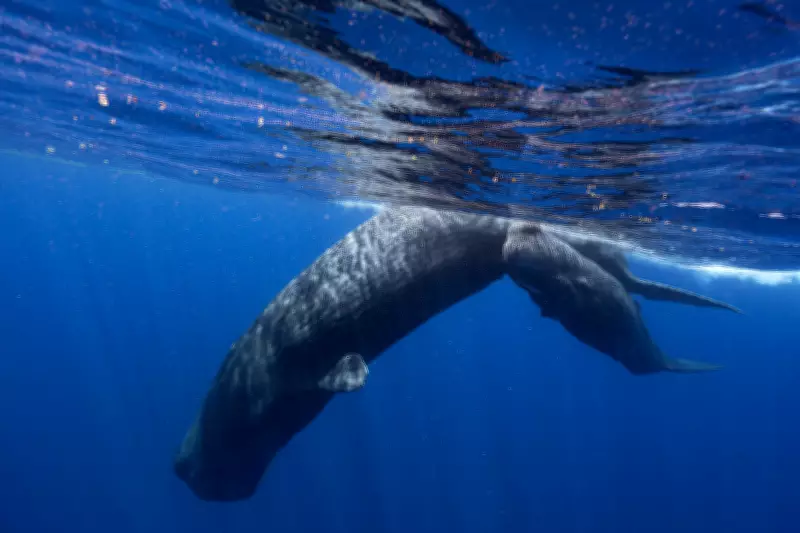
Sperm Whale Communication Mirrors Human Language Structure, Groundbreaking Study Reveals
A landmark scientific study published in April 2026 has uncovered that sperm whales utilize a sophisticated communication system bearing remarkable structural parallels to human language. This research, led by an international team of marine biologists and linguists, represents a significant leap forward in understanding cetacean intelligence and social complexity.
Decoding the Click-Based Language of the Deep
The study focused on analyzing the distinctive click sequences, known as codas, that sperm whales use to communicate in the ocean's depths. Researchers employed advanced audio recording equipment and artificial intelligence algorithms to decode patterns within thousands of hours of whale vocalizations recorded near Dominica in the Caribbean Sea.
The findings revealed that sperm whale communication exhibits several key features previously thought unique to human language:

- A combinatorial structure where individual clicks combine to form meaningful sequences
- Evidence of syntax-like rules governing how these sequences are arranged
- Context-dependent variations in communication patterns
- Distinct "dialects" among different sperm whale social groups
Implications for Understanding Animal Intelligence
This discovery challenges long-held assumptions about the uniqueness of human language and provides compelling evidence for complex cognitive abilities in marine mammals. The research suggests that sperm whales may be capable of conveying specific information about their environment, social relationships, and potentially even abstract concepts through their click-based communication system.
Dr. Robin Della Corte, the study's lead author, emphasized the significance of these findings: "What we're observing in sperm whale communication shares fundamental organizational principles with human language. This doesn't mean they're speaking English, but rather that both species have evolved complex systems for structuring information exchange."
Research Methodology and Future Directions
The research team utilized non-invasive recording devices attached to whales using suction cups, allowing them to capture both the whales' vocalizations and their corresponding behaviors. Machine learning algorithms then identified patterns within the acoustic data that revealed the underlying structure of whale communication.
Future research aims to:
- Expand the study to additional sperm whale populations worldwide
- Investigate whether specific click combinations correspond to particular meanings
- Explore how whale calves acquire their group's communication patterns
- Compare sperm whale communication with that of other cetacean species
This groundbreaking work not only deepens our understanding of marine mammal cognition but also raises important questions about conservation ethics and how we perceive intelligence in non-human species. As research continues, scientists hope to further unravel the mysteries of what these majestic creatures might be saying to one another in the ocean's depths.