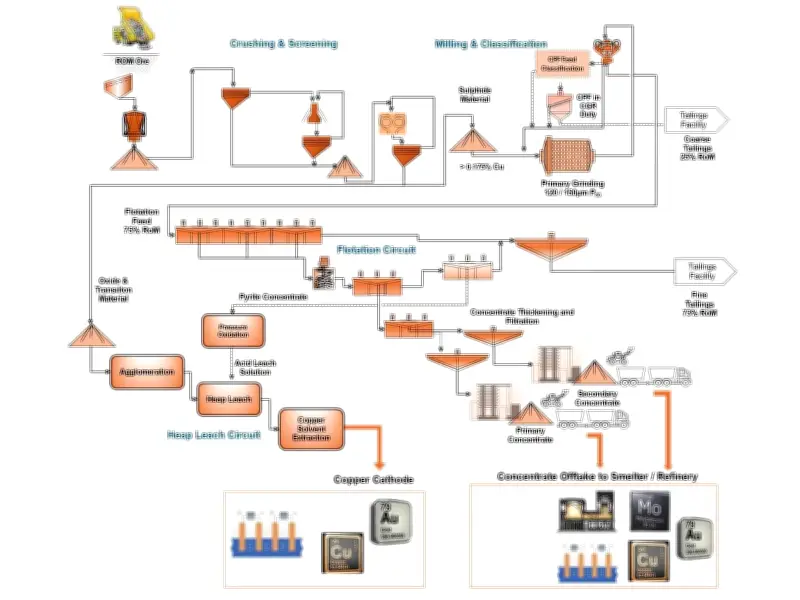
Koryx Copper Inc. has announced significant progress on its wholly-owned Haib Copper Project in southern Namibia, with the pre-feasibility study (PFS) on track for publication before the end of 2026. The company reported that process flow sheet optimization is largely complete, potentially leading to substantial production and cost improvements.
Key Project Highlights
The optimization is driven by an improved mineral resource estimate, an optimized mine plan, and various process flow sheet enhancements, including the application of coarse particle flotation (CPF) to reject low-value waste rock. Test work confirms that using CPF in the milling circuit is expected to reject up to 25% of run-of-mine feed as coarse tailings with only limited copper loss. The processed mill feed grade is expected to increase significantly after coarse gangue rejection via CPF.
CPF is a proven flotation technology that removes low-value waste rock at coarse particle size before finer grinding and processing, thereby reducing waste rock, increasing throughput, reducing water and energy consumption, and improving tailings handling and volumes.

Potential Economic Improvements
The upcoming PFS is expected to demonstrate significant improvements in overall project economics, ranging from potential increases in throughput, grade, annual copper production, and life-of-mine to potential reductions in stripping ratio, unit cost, and process flowsheet simplification. All sulphide material, including previously classified sulphide heap leach material, is now expected to be treated through conventional milling and flotation, eliminating the need for sulphide heap leaching and potentially saving significant capital expenditure while simplifying the flow sheet.
This approach produces the best overall metallurgical performance and has been adopted as the PFS base-case flow sheet for all sulphide material.
Infrastructure and Permitting Progress
Power supply will be sourced from a 200 MVA connection to the Namibian national grid, augmented with hybrid solar photovoltaic and battery storage. Water supply will come from the Orange River combined with an off-site storage dam for 20 million cubic meters per year. An additional option involving the Neckartal dam and pipeline for future expansion is under review.
Environmental and permitting work is progressing, with 13 specialist studies completed and environmental approval targeted for the first half of 2027. The company continues to fast-track the publication of the PFS before the end of 2026.
Management Commentary
Heye Daun, Koryx Copper's President and CEO, commented: "We are very excited with the progress our in-house study team and specialist EPCM consultants are making with the PFS for our flagship Haib Cu-Mo-Au project, which is planned to be published in late 2026. Recent metallurgical test work confirms the potential to significantly increase the processing grade going into flotation by using Eriez' well-proven HydroFloat system for coarse particle flotation. Utilizing CPF in a coarse gangue rejection application, flotation processing grade is expected to increase to between 0.45% and 0.50% on a copper equivalent basis in the first ten years."
Daun added: "With the expected higher processing grade, increased tonnage, and simplified flow sheet, we anticipate the potential for a significant improvement in project economics with the upcoming PFS. We have also made a lot of progress with further defining the Haib infrastructure plans, especially relating to power, water, and tailings storage. Grid power will be sourced from the nearby Namibian national grid, augmented with hybrid solar PV and battery storage to deliver reliable, low-carbon energy. Our water supply strategy is based on accessing water from the nearby Orange River, in combination with significant on-site water storage to address seasonality. Our ESIA permitting process is also advancing, with all specialist baseline studies completed, and application for environmental clearance expected to be submitted mid-year. Given typical Namibian regulatory practice, environmental approval is targeted for approximately mid-2027."

What is Coarse Particle Flotation?
Coarse Particle Flotation is an innovative but commercialized technology that combines density separation with traditional froth flotation within an aerated fluidized bed. Unlike conventional flotation cells that rely entirely on bubble buoyancy in turbulent tanks, CPF techniques such as the well-proven Eriez HydroFloat introduce slurry into an upward-flowing current of water and air bubbles, enabling efficient recovery of coarse particles.