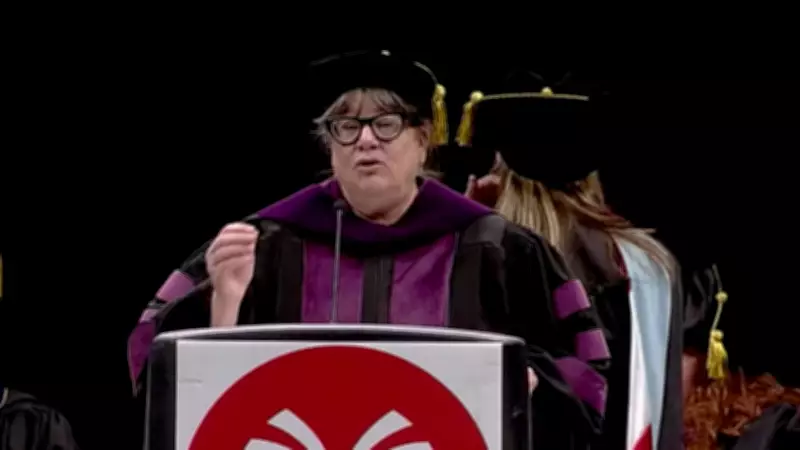
Students at Glendale Community College expressed their discontent by booing the school’s president when she revealed that artificial intelligence had been used to read aloud students’ names during a graduation ceremony, resulting in several names being missed.
Incident at Glendale Community College
“Graduates, everyone who is standing, here’s what’s happening,” Tiffany Hernandez, president of Glendale Community College, told the crowd during Friday’s graduation ceremony. “We’re using a new AI system as our reader.” The crowd then began to boo loudly.
“So that is a lesson learned for us,” Hernandez said. “What we were able to do though is each of you were able to walk the stage and get a picture, which is what I would hope would be the most meaningful.” Despite her explanation, the students continued to boo. Hernandez then clarified that students would not be able to walk the stage a second time.

A spokesperson for the Maricopa County Community College District issued a statement apologizing for the “technical issue.” “While the issue was corrected during the ceremony, we are sorry for the disruption it caused during what should have been a celebratory moment for our graduates and their families,” the statement read. “We have also communicated directly with graduates to apologize for the experience. We are incredibly proud of all our graduates and are taking steps to ensure an issue like this does not occur again.”
Broader Trend of AI Backlash at Commencements
With graduation ceremonies taking place across the country, students are increasingly vocalizing their opinions about artificial intelligence, often by booing speakers who advocate for its adoption. This trend was evident at other institutions as well.
At the University of Central Florida’s College of Arts and Humanities graduation ceremony on May 8, Gloria Caulfield, vice president of strategic alliances for Tavistock Development Company, faced a similar response during her commencement speech. “The rise of artificial intelligence is the next industrial revolution,” she said, prompting immediate booing from the audience. Looking confused, she turned to other speakers onstage and asked, “What happened?” She then addressed the crowd, saying, “OK, I struck a chord. May I finish?” She continued, “Only a few years ago, AI was not a factor in our lives,” to roaring applause. “All right, we’ve got a bipolar topic here I see.”
Ethan Lubin, a graduate of the University of Central Florida, was among those who booed. “Talking about artificial intelligence at a college for arts and humanities can be, you know, a bit rough,” Lubin told The New York Times, “because it kind of goes against the humanities part.” Tavistock Development Company did not immediately respond to a request for comment.
AI in Higher Education
Artificial intelligence has grown exponentially in modern society in recent years, and universities have been quick to adopt it in classrooms. According to a 2026 study from the Lumina Foundation-Gallup 2026 State of Higher Education, four in 10 college students reported being encouraged to use AI. The majority of students surveyed use AI in their coursework, but those who do not often cite ethical reasons.
Eric Schmidt, billionaire and former CEO of Google, was also booed during the University of Arizona’s graduation ceremony on Friday after mentioning that “The architects of AI” were named Time’s 2025 Person of the Year. “So today we stand on this edge of another technological transformation. One that will be larger, faster, and more consequential than what came before. It will touch every profession, every classroom, every hospital, every laboratory, every person and every relationship you have,” Schmidt said while the crowd continued booing. “I know what many of you are feeling about that. I can hear you. There is a fear in your generation.”