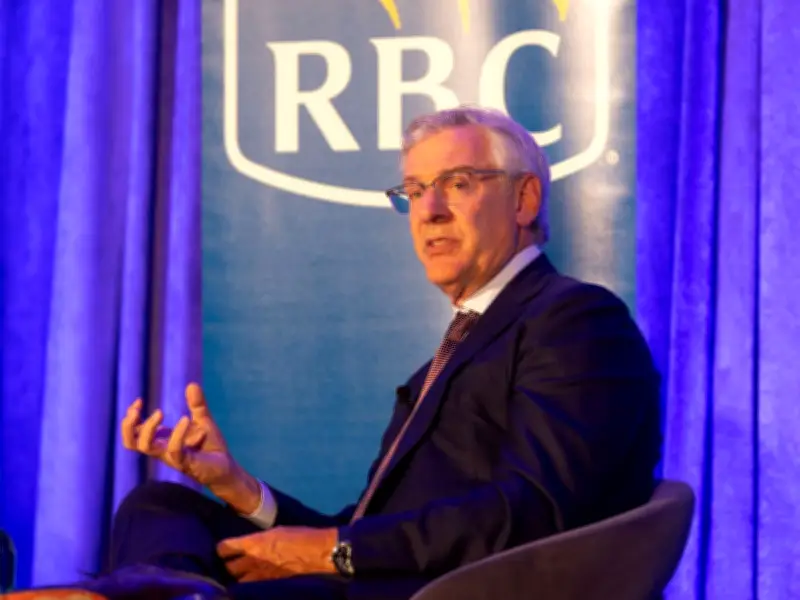
Dave McKay, chief executive of Royal Bank of Canada, says he spends an hour every morning reading a report generated by a customized artificial intelligence tool that provides him with key insights and helps him be more efficient with his team.
It is part of McKay's newly designed office that includes a suite of AI tools relying on both internal data from the bank and external data.
"Instead of sending an email at night asking (my team) to produce a report, getting that report a week later, digesting it and calling them about the answer, I get that report in about four seconds," he said at a Bloomberg event in Toronto on Tuesday. "It's built on our data and, obviously, an LLM (large language model) searching the entire universe of information."

AI integration across Canadian banks
Canada's Big Six banks have been trying to increase their use of AI to boost productivity and earnings. RBC has said it wants to get up to $1 billion in AI-driven enterprise value by 2027.
Last week, Bank of Nova Scotia said it was using AI to strengthen key programs, such as its anti-money laundering detection system. In April, Toronto-Dominion Bank chief executive Raymond Chun said using AI had cut down reviews of its mortgage approval process to minutes from hours and it was also sending auto-loan decisions within seconds to clients at dealerships.
The move to invest more in AI has come at a time when the country's top banking regulator has urged financial institutions to better understand and manage the technology's potential risks.
In April, Peter Routledge, head of the Office of the Superintendent of Financial Institutions, said the emergence of Anthropic PBC's Mythos — an AI model that reportedly excels at exploiting software vulnerabilities — is a signal point for the financial system to "put on our thinking caps and our glasses" to understand what risks artificial intelligence poses.
McKay's daily AI routine
McKay said RBC's AI model allows him to get insights on things such as the macroeconomy, consumer behaviour and the mortgage business. He said the "incredible amount of internal and external data" gives him unique insight that he eventually takes back to his team.
"I still invariably call my team and say, 'Hey, the model told me this … does that seem intuitively right?'" he said. "For me, the model adds value and it leads me to ask, 'What should we be doing differently?' so it shortens the conversation."
But McKay said he does not see the bank's increasing reliance on AI leading to staff cuts. Instead, he expects AI to increase capacity, reduce processing speed and allow RBC to get more customers. RBC currently serves 17 million people and its goal is to increase that to 25 million.