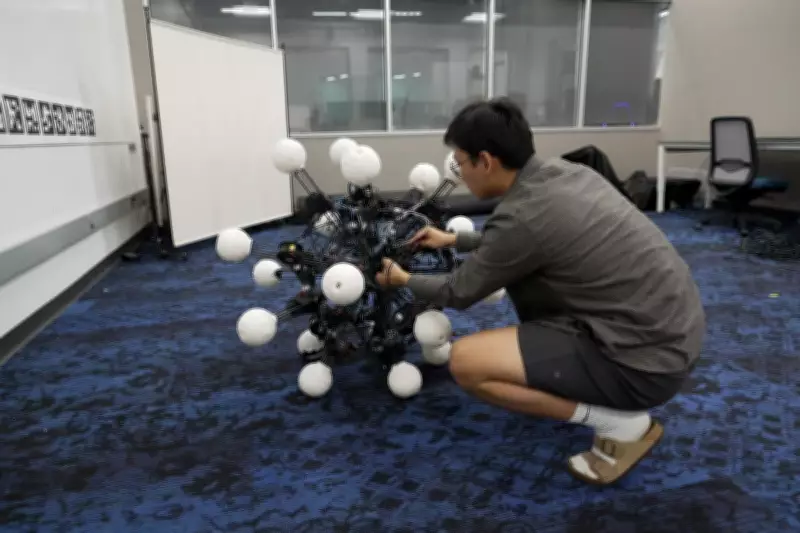
Researchers at Duke University have introduced a groundbreaking robot named Argus, featuring 20 legs and a unique vision system that allows it to move and see in any direction instantly. The robot, developed at the General Robotics Lab, draws inspiration from insects' ability to navigate complex environments with agility and awareness.
Design and Capabilities
Argus is equipped with multiple cameras that provide a 360-degree field of view, eliminating blind spots. Its 20 legs enable rapid direction changes without the need to turn its body, mimicking the efficiency of arthropods. This design allows the robot to traverse uneven terrain and avoid obstacles with unprecedented speed.
Potential Applications
The robot's capabilities could revolutionize search and rescue operations, environmental monitoring, and exploration in hazardous environments. Its ability to perceive and react to surroundings instantly makes it ideal for missions where split-second decisions are critical.

Lead researcher Jiaxun Liu, a Ph.D. student, demonstrated Argus's agility in a lab setting, highlighting its potential for real-world deployment. The team plans to refine the robot's AI algorithms to enhance autonomous navigation.
Significance
Argus represents a significant leap in robotics, combining multi-legged locomotion with omnidirectional vision. This integration could lead to more resilient and adaptable robots for various industries, from disaster response to space exploration.
The project underscores Duke University's commitment to advancing robotics technology. Future iterations may include improved energy efficiency and payload capacity, expanding its utility.