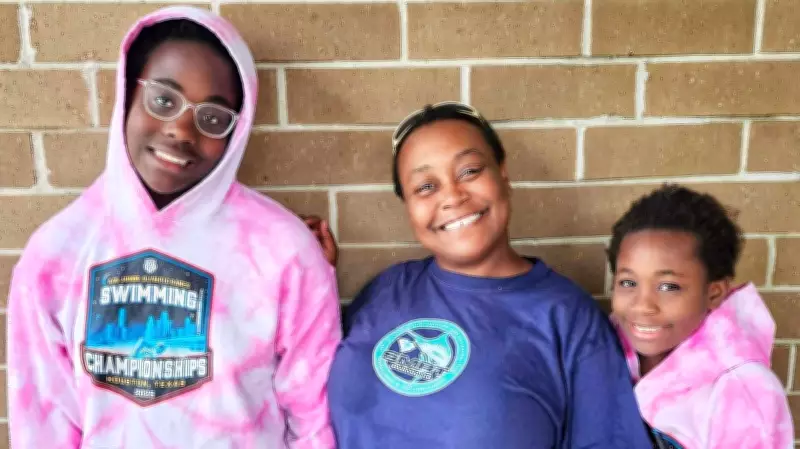
My grandmother never entered a swimming pool in her lifetime. The nearest she came was one afternoon when I held my phone before her, angling the small, luminous display so she could watch her great-granddaughters, Zuri and Amara, cutting through vibrant blue water at a swim meet. They were young then, just starting to compete. Her eyes, weary yet perceptive, fixed on the screen. "Shana," she murmured, squinting, "what is that girl doing in that water?!" Her voice carried genuine fear—not born of ignorance, but steeped in history. "She's racing, Grandma," I reassured her. "That's Zuri. Don't worry—she's safe." She leaned in closer, observing those small arms churning vigorously. "Do they like swimming?" "They love it." She nodded slowly, her gaze lingering. "I never did learn to swim, baby. Never even been in a pool." I squeezed her hand. "I know. But we aim to change all that with Zuri and Amara." What remained unspoken was that this endeavor transcended mere safety; it was about rewriting a narrative.
The Historical Context of Swimming Access
My grandmother never acquired swimming skills, but my mother did. During her childhood, gleaming public pools were not welcoming spaces but sites of exclusion. Under segregation, Black families faced outright bans from entry. When desegregation arrived, many municipalities opted to shut down pools entirely rather than integrate them. Access to water—something so fundamental and innocent—became a subtle indicator of belonging. The repercussions persist today. According to the Centers for Disease Control and Prevention, Black Americans drown at rates approximately 1.5 times higher than white Americans, with disparities particularly acute among children. In swimming pools, Black children aged 10–14 drown at rates 7.6 times higher than white children. Public health experts attribute these gaps partly to generations of unequal access to pools and swim instruction.
A Mother's Determination to Break the Cycle
In the late 1970s, my mother defied these barriers. Just two months after giving birth to me—the first of her seven children—she enrolled in swim lessons. Her rationale was clear: if she learned, her children would not inherit fear as an instinct. As we grew up in Charleston, a city where water seems to dominate the landscape with wide rivers, winding marshes, and a nearby ocean, she ensured every one of us took lessons. Each summer, we visited W.L. Stephens pool, immersed in the scent of chlorine, the echo of whistles, and the sun's sting on wet shoulders. We grew stronger annually. My brother and I continued lessons into high school, focusing on safety through yardage, endurance, and treading water until our legs trembled. In our family, swimming was non-negotiable.

Yet, "basic" has not always equated to "accessible." Many of our Black and brown friends did not take lessons. They frequented the pool but stayed near the edges, where waves gently met gutters and decks. My siblings and I could venture farther out—not recklessly, but with confidence. Water became our ally, not a stranger.
Passing the Torch to the Next Generation
Years later, I found myself in the bleachers at that same W.L. Stephens pool, now as a mother. Zuri, at age 7, participated in her first swim meet for the 25-yard freestyle—small, serious, with slightly askew goggles. The buzzer sounded, she dove, and touched the wall first. Her coach approached me, eyes wide. "Looks like her time was one of the fastest in the state for her age group." One of the fastest in the state, in the very pool where I learned to tread water, where my mother insisted we master swimming. I felt past and future collide in the chlorinated air.
Unexpectedly, Zuri fell in love with racing. At 8, she swam anchor at the 8 & Under State Championships. Her team, seeded low, relied on her as the fastest swimmer in the relay. She dove and touched first, securing a state championship for her team. I covered my mouth, tears flowing unbidden—not just for her time, but for the interrupted inheritance.

A Legacy of Resilience and Record-Breaking
Years later, at her final Age Group State Championship, Zuri stood on the blocks again as anchor. The same pool, but she was older and stronger. The natatorium buzzed with energy. The starter beeped, she dove with quiet poise and remarkable strength, and I held my breath. When she touched the wall, the scoreboard flashed: 24.91 seconds, under 25, on a relay at age 14. Three other girls had poured their all into the water before her dive. Four bodies, one finish. They shattered their team record and placed third in the state—less than a second from first. Once more, I covered my mouth, crying. It was not merely about time; it was about the inheritance, disrupted.
There were few girls who resembled her in that heat. USA Swimming reports that roughly 2% of its membership is Black. Two percent—an improvement from my grandmother's era and my mother's, yet still notably low. I ensure Zuri does not bear this weight alone; from me, she receives steadiness. Her dreams are her own.
Conclusion: From Exclusion to Possibility
My grandmother passed away in March 2024, never having stepped into a pool. Yet, she empowered the next three generations to move forward regardless. In just four generations, a grandmother was barred from entry, a mother stepped in defiantly, a daughter made swimming non-negotiable, and now a great-granddaughter anchors relays and breaks records with teammates. This journey embodies unconditional love, lifetimes of growth, and development. I miss my grandmother deeply, but she witnessed the dawn of this transformation, a significance beyond words. Water once symbolized exclusion; now, in our family, it represents boundless possibility. And that, indeed, feels like victory.