More than a decade ago, when Teresa Resch moved to Canada from the United States to join the Toronto Raptors, she walked around Toronto's Queen West neighbourhood hoping to catch the NBA season opener and was surprised to find no bars playing the game.
In a way, it made sense. Resch arrived in 2013, soon after Masai Ujiri took charge of the Raptors, but before the team's rise had turned it into a contender — and before their 2019 championship run helped convert so many Canadians into fans of the team and the league.
"In the NBA, there are only two games on opening night, and one is the ring ceremony, which the Raptors weren't in that long ago," she said.

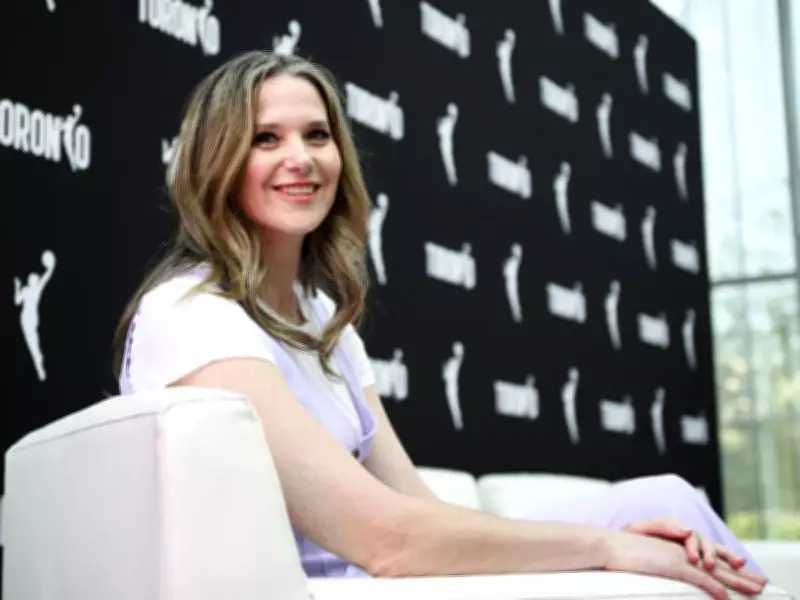
Resch expects a different scene this week across the country as the Toronto Tempo open their inaugural season May 8 at Coca-Cola Coliseum as the WNBA's first international expansion team.
"I think that basketball in this country has grown a lot in the last 13 years," she said. "I love that this country's embraced it in so many ways."
As president of the Tempo, Resch is now trying to turn that momentum into a national following, building a team she hopes will resonate across the country and become Canada's team.
"The Raptors became Canada's team over time. We get to build it that way from day one," she said.
What is Resch's basketball background?
Heading up one of the WNBA's most-anticipated expansion teams wasn't necessarily a goal Resch had on her vision board at the start of her career. After stints at the NBA league office and Life Time Fitness, Resch relocated to Toronto as a 32-year-old with a growing resume and a willingness to take on something new.
Through her time with the Raptors, she built a reputation as a builder, helping lead projects ranging from the team's practice facility to the launch of Raptors 905. When she resigned from her position as vice president of basketball operations in 2024, she was recognized by Ujiri, who spoke at her going-away party.
She describes her leadership style as collaborative but demanding — direct and inclusive, but unafraid to push people beyond their comfort zones.
Resch has leaned into that approach while building the Tempo, focusing on clarity and alignment across a rapidly growing staff.
"It's more about providing clear direction — these are our priorities, these are our goals — and also positive support," she said. "I think it's my job to make sure people take a step back and see the bigger picture."
And while nearly every part of the Tempo is built from scratch, Resch's relationship with Ujiri is one of the few things that is not. In March, it was announced that he would join Raptors governor Larry Tanenbaum and Serena Williams as part of the team's principal ownership group. Ujiri is not involved in the team's daily operations, Resch said, but occasional check-ins still carry the weight of a relationship built over 12 years of working side by side.
"It's someone that I am super familiar with, you don't have to tiptoe around or figure it out," she said.
How do you become 'Canada's team'?
Building "Canada's team" has required thinking beyond Toronto from the outset. The Tempo have already marketed across the country and plan to play home games on the road at Rogers Arena in Vancouver and the Bell Centre in Montreal.
National sponsors such as CIBC and Sephora have also signed on with the expectation of activating nationwide, extending the team's reach beyond its home market.
Internally, the message has been just as clear: Players represent not just a city, but an entire country, a distinction Resch says was instrumental in attracting free agents.
"It was a big part of what we told them this was going to be about — you have an entire country behind you," she said. "They understand how that's different than any other market in this league."
Of course, earning that place in the hearts and minds of Canadians will at some point require winning. Resch learned all about that on her way to earning a championship ring with the Raptors. "You could feel the entire country kind of following, jumping on the bandwagon, becoming part of this incredible 'We the North' movement," she said.

She has a plan for winning with the Tempo, too. To help field a competitive roster, she hired two-time WNBA champion Monica Wright Rogers as the franchise's first general manager, someone she said brings both experience and a strong understanding of what it takes to build a team from the ground up.
"She's a first-time GM but she has incredible experience within the WNBA," Resch said. "More than anything, she's just an incredible person … she has a really high EQ, and as a former player, she's done it."
Moving in fast-forward
April underscored just how compressed the build has been. A new collective bargaining agreement created both opportunity and chaos across the league, accelerating free agency and roster construction into a matter of weeks. As Resch noted after the team's first pre-season game, "It hasn't even been a month since we got our first player."
That pace left little time for a group of entirely new players and staff to come together before opening night.
The Tempo have assembled a mix of experienced veterans and international talent but, like any expansion team, questions remain about how quickly the group can come together and compete in a league where depth and continuity are often decisive.
With limited time to build chemistry and a compressed runway into the season, the early focus will be less on identity and more on execution and how quickly that can translate into results.
Casual fans may recognize just one name on the roster: The lone Canadian, Kia Nurse, a three-time Olympian whose family spans the country's sporting landscape; her brother, Darnell Nurse, plays for the Edmonton Oilers, while her cousin, Sarah Nurse, stars for the Vancouver Goldeneyes.
Yet even as the franchise looks to build "Canada's team" with just one Canadian on the hardwood, Nurse served up a modern-day Canadian heritage moment, scoring the Tempo's first basket — a three-pointer — in their pre-season debut against the Connecticut Sun.
"It was a really special moment for all of us … just to see it actually come to life after all the work that's gone into it," Resch said the following morning.
As a Sceptres season-ticket holder, she has been to many games at Coca-Cola Coliseum, but nothing compares to watching her own dream come to life in the building.
"I wanted (team staff) to take a second and just soak it in. This doesn't happen very often, and it's a pretty special moment," she said.
It's the kind of moment she's been noticing more and more. She felt it again after the team's first preseason media day, where the scale of attention offered an early glimpse of what it might mean to represent an entire country.
"One of the players was like, 'Wow, this is full,'" Resch said. "I don't think they're used to that many people covering a team."
Players, many of them new to both the city and the league, were struck by the volume of media and the level of interest — a reflection, Resch believes, of something beginning to take shape.
Years after she walked through Queen West unable to find a bar showing the game, she has no questions about where the WNBA's season opener will be playing: "Where is it going to be played? It's going to be played in every single bar in this country."