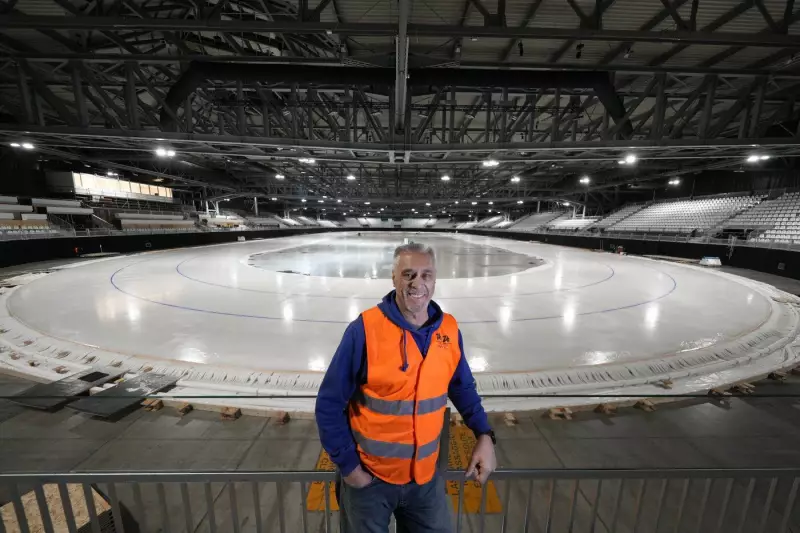
In a landmark achievement for winter sports, a Canadian expert from Calgary has secured his place in Olympic history. Mark Messer, renowned as an Ice Master, has successfully engineered the first indoor temporary speedskating rink ever used for the Winter Games. This pioneering project is set for the Milan Cortina 2026 Olympics.
A Groundbreaking Engineering Feat
The historic rink is located within the stadium in Rho, on the outskirts of Milan, Italy. Messer, whose expertise is often sought for world-class ice conditions, oversaw the complex creation of this temporary competition surface. Unlike permanent venues, constructing a world-standard speedskating oval inside a non-specialized building presents immense technical challenges, from precise temperature and humidity control to ensuring the perfect ice consistency for record-breaking performances.
Photographs from Tuesday, November 11, 2025, show Messer posing confidently within the stadium, marking a significant milestone ahead of the Games. This innovation solves a key logistical hurdle for host cities, potentially allowing more flexibility in venue selection and reducing the need for costly, permanent infrastructure that may see limited use after the Games conclude.

The Calgary Connection to Olympic Ice
Mark Messer's accomplishment underscores Canada's, and particularly Calgary's, deep-rooted legacy in winter sports excellence. Calgary is home to the Olympic Oval, a world-renowned speedskating facility built for the 1988 Winter Olympics. The expertise cultivated in such environments directly contributes to groundbreaking projects like the one in Milan.
This project is not just about laying down ice; it's about replicating the exacting conditions that elite athletes require. The temporary rink must meet the stringent standards set by the International Skating Union, ensuring fairness and safety for all competitors during the Olympic events.
Implications for Future Winter Games
The successful deployment of this indoor temporary speedskating rink sets a powerful precedent. It demonstrates a viable model for future Olympic hosts, especially those in regions or cities without pre-existing, sport-specific venues. This can lower entry barriers for hosting, promote sustainability through reduced construction, and allow the Games to reach new audiences.
For the Milan Cortina 2026 Games, Messer's work ensures that speedskating events will proceed on a surface worthy of Olympic champions. His role bridges Canadian technical prowess with the global Olympic movement, showcasing innovation that directly impacts athlete performance and the spectator experience.
As the world turns its attention to Italy in 2026, the ice beneath the speedskaters' blades will bear the imprint of a Canadian's historic ingenuity, marking a new chapter in how Winter Olympic facilities are conceived and built.